

 English
 Français
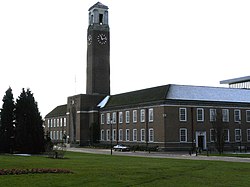
Salford Civic Centre
Salford Civic Centre, formerly Swinton and Pendlebury Town Hall, is a municipal building at Chorley Road, in Swinton, Greater Manchester, England. It is the administrative headquarters of Salford City Council.
Nearby Places View Menu

123 m
Salford and Eccles
Salford and Eccles was a constituency in the House of Commons of the UK Parliament. For its entire creation since 2010, it was represented by members of the Labour Party.
Further to the completion of the 2023 Periodic Review of Westminster constituencies, the seat was abolished. Subject to boundary changes, involving the loss of Eccles, it was reformed as Salford, which was contested at the 2024 general election.

138 m
Church of St Peter, Swinton
The Church of St Peter is an Anglican parish church on Chorley Road in Swinton, a town in the City of Salford, Greater Manchester, England. Serving the historic parish of Swinton and Pendlebury, it forms part of the ecclesiastical deanery of Eccles in the Diocese of Manchester. The present building was erected between 1868 and 1869 to accommodate the area's rapidly expanding industrial population and to replace an earlier chapel of ease. Designed by the architect G. E. Street in the Gothic Revival style, it is recorded in the National Heritage List for England as a Grade II* listed building.

153 m
Swinton, Greater Manchester
Swinton is a town in the City of Salford in Greater Manchester, England. southwest of the River Irwell, 4 miles (6.4 km) northwest of Manchester, adjoining the town of Pendlebury and suburb of Clifton. In 2014, it had a population of 22,931.
Historically in Lancashire, for centuries Swinton was a hamlet in the township of Worsley, parish of Eccles and hundred of Salfordshire. The name Swinton is derived from the Old English "Swynton" meaning "swine town". In the High Middle Ages, Swinton was held by the religious orders of the Knights Hospitaller and Whalley Abbey. Farming was the main occupation, with locals supplementing their incomes by hand-loom woollen weaving in the domestic system.
Collieries opened during the Industrial Revolution and Swinton became an important industrial area with coal providing the fuel for the cotton spinning and brickmaking industries. Bricks from Swinton were used for industrial projects including the Bridgewater Canal, which passes Swinton to the south. The adoption of the factory system facilitated a process of unplanned urbanisation in the area, and by the mid-19th century Swinton was an important mill town and coal mining district at a convergence of factories, brickworks and a newly constructed road and railway network.
Following the Local Government Act 1894, Swinton was united with neighbouring Pendlebury to become an urban district of Lancashire. Swinton and Pendlebury received a charter of incorporation in 1934, giving it honorific borough status. In the same year, the United Kingdom's first purpose-built intercity highway—the major A580 road (East Lancashire Road), which terminates at Swinton and Pendlebury's southern boundary—was officially opened by King George V. Swinton and Pendlebury became part of the City of Salford in 1974. Swinton is the seat of Salford City Council and a commuter town, supported by its transport network and proximity to Manchester city centre.
189 m
Swinton Square
Swinton Square, formerly known as Swinton Shopping Centre, is a shopping centre located between Chorley Road (A6) and Swinton Hall Road in Swinton, near Manchester, England.
The centre was built in 1966. Swinton Square houses a diverse number of shops, with many specialising in a certain area of life. It also held a small open air market until fairly recently. The complex includes the 1970s Swinton Library and the Lancastrian Hall As part of the recent redevelopment of the shopping area, a new Asda superstore opened in 2014. There is also a Morrisons superstore nearby on Swinton Hall Road, which was originally built in 1992 as a Safeway UK store, until Morrisons acquired the Safeway chain in 2004. The store was eventually rebranded to Morrisons in November 2005.