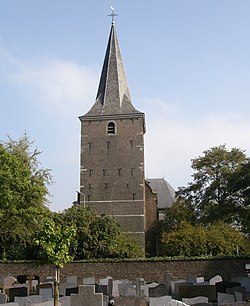
Schaesberg (Dutch pronunciation: [ˈsxaːzbɛr(ə)x]; Limburgish: D'r Sjeet [dəʀ ˈʃeːt]) is a neighbourhood of Landgraaf and former village in the Dutch province of Limburg.

1. History

The village was first mentioned in 16th century as Gaesberg. The etymology is unknown. Schaesberg developed in the 17th century between the Schaesberg and Strijthagen castles from the 13th century. In 1618, it became a heerlijkheid. In 1661, it became part of the Spanish Netherlands, and in 1713 an enclave of the Austrian Netherlands within the Dutch Republic. In 1785, it became part of the Dutch Republic. The Catholic Peter and Paul Church was founded in 1648. In 1699, it was expanded and a tower was attached. Strijthagen Castle was built in 1530, but probably had a 13th century predecessor. It received its current form around 1700. Schaesberg castle was abandoned in 1733, and only ruins remain. Schaesberg was home to 710 people in 1840. A railway station was built in 1896 on the Sittard to Herzogenrath (Germany) railway line. In 1949, a railway line to Simpelveld was added. The railway station was renamed Landgraaf in 1986, and the line to Simpelveld closed in 1988. In 1905, mine workers colonies were built in Schaesberg, and the village started to grow. Schaesberg was a separate municipality until 1982, when it merged with Nieuwenhagen and Ubach over Worms to form the new municipality Landgraaf. It also became a neighbourhood of Landgraaf.

1. Gallery


1. References


1. External links

Media related to Schaesberg at Wikimedia Commons

Nearby Places View Menu
Location Image
0 m

Landgraaf

Landgraaf (Dutch: [ˈlɑntxraːf] ; Limburgish: Lankgraaf [ˈlɑŋkxʀaːf]) is a municipality in southeastern Limburg, Netherlands, forming part of the Parkstad Limburg agglomeration. SnowWorld is the largest indoor ski piste in Europe.
Location Image
465 m

Landgraaf railway station

Landgraaf is a railway station in Landgraaf, Netherlands, situated near the district Schaesberg. Before 1986, it was called Schaesberg. The station was opened on 1 May 1896 and is located on the Sittard–Herzogenrath railway and the Heuvellandlijn (Maastricht–Kerkrade). Services are operated by Arriva and Deutsche Bahn. Originally named Schaesberg, it was renamed in 1986 after the municipality of Landgraaf, which was formed in 1982 and includes Schaesberg. The Heerlen-Kerkrade line, which serves Landgraaf, was electrified in 1986, and the line to Herzogenrath was electrified in 2018. The station can be considered a fork station. Facilities at the station include a ticket machine, bike lockers, a bike storage area, and car parking spaces. The former station building now houses an Italian restaurant. Event Platform In 2012, ProRail extended one of the platforms from 85 to 146 meters and widened it from 3 to 6 meters to accommodate longer trains for the Pinkpop festival. Festival director Jan Smeets officially opened the platform with a special 'Pinkpop tile' on May 24, 2012. Connections Landgraaf Station has three tracks: tracks 1 and 2 are on the Sittard-Kerkrade line, and track 3 is on the Maastricht-Aachen line.
1.1 km

Oranje Nassau II

The Oranje Nassau II was a Dutch coal mine located in Schaesberg. The mine was in operation from 1904 until 1971. It was the second of four mines collectively known as the Oranje Nassau Mijnen. When the first coal was extracted in 1904, high production levels were not yet achieved. The mine was not connected to the railroad and the coal had to be hauled to the Schaesberg station by horse and carriage. In 1906 the mine was in full production as the railways to Heerlen were finished. This railway was also used by the Staatsmijn Wilhelmina. Until its closure, a total of 34,065,000 tons of coal were brought to the surface. The highest production was reached in 1930 with 687,000 tonnes. In the last year that the mine was still in production (1970) 506,000 tonnes were won.
1.2 km

Nieuwenhagen

Nieuwenhagen is a former village in the Dutch province of Limburg. It is now a part of the municipality of Landgraaf. Nieuwenhagen was a separate municipality until 1982, when it became a part of Landgraaf.