

 English
 Français

Guildhall, Kingston upon Hull
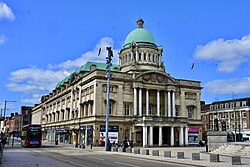
The Guildhall is a building on Alfred Gelder Street in the City of Kingston upon Hull, East Riding of Yorkshire, England. The building is currently the headquarters of Hull City Council but is also used as a venue for conferences, civic receptions and formal dinners. It is a Grade II* listed building.
Nearby Places View Menu
51 m
Kingston upon Hull
Kingston upon Hull, or simply shortened to Hull, is a port city and unitary authority area in the East Riding of Yorkshire, England. It lies upon the River Hull at its confluence with the Humber Estuary, 25 miles (40 km) inland from the North Sea. It is a tightly bounded city which excludes the majority of its suburbs; with a population of 275,401 (2024), it is the fourth-largest city in the Yorkshire and the Humber region. The built-up area has a population of 436,300.
Hull has more than 800 years of seafaring history and is known as Yorkshire's maritime city. The town of Wyke on Hull was founded late in the 12th century by the monks of Meaux Abbey as a port from which to export their wool. Renamed Kings-town upon Hull in 1299, Hull had been a market town, military supply port, trading centre, fishing and whaling centre and industrial metropolis.
Hull was an early theatre of battle in the English Civil Wars. Its 18th-century Member of Parliament, William Wilberforce, took a prominent part in the abolition of the slave trade in Britain.
The city offers a variety of museums and art galleries, a city centre marina and historic old town, stunning architecture, and a thriving arts scene. Due to Hull's growing appeal as an outdoor film location, particularly for period dramas using the Old Town's historic streets and buildings, plans for a purpose-built film studio complex have been approved by Hull City Council. The £3m complex could open by the end of 2025. The city has earned the nickname "Hullywood" in recent years, after productions including The Crown, Enola Holmes 2, The Personal History of David Copperfield, Victoria and Blitz have been filmed in the city.
In 2017, it was the UK City of Culture and hosted the Turner Prize at the city's Ferens Art Gallery. Other notable landmarks in the city are the Minster, the tidal surge barrier, the Paragon Interchange and The Deep Hull's award-winning aquarium. Areas of the town centre include the old town (including its museum quarter) and the marina. The University of Hull
was founded in 1927 and had over 16,000 students in 2022. Rugby league football teams include clubs Hull F.C. and Hull Kingston Rovers. The city's association football club is Hull City (EFL Championship). Hull RUFC and Hull Ionians both play in the National League 2 North of rugby union.
The city came 2nd in the Time Out list of the 15 best places to visit in the UK in 2024, with the guide commenting that the city has got "The Deep, an enormous aquarium with 3,000 species, a picturesque old town which survived the city's relentless WWII bombings, and lots of up and coming indie art galleries like Ground and Artlink. Don't sleep on Hull". In 2016, it was named as one of the top 10 cities in the world to visit by Rough Guides alongside cities such as Seoul, Vancouver, Amsterdam and Reykjavik. In 2017, the city was featured in The Sunday Times Best Places to Live Guide and in 2024 was named as one of the UK's most "up and coming" places to move to. however, Kingston upon Hull has been ranked as one of the most deprived cities in the UK and the fourth most deprived local authority in the country. The city also has a lower than average life expectancy than the majority of the UK.
52 m
Timeline of Kingston upon Hull
The following is a timeline of the history of the city of Kingston upon Hull, East Riding of Yorkshire, England.
97 m
Siege of Hull (1643)
The unsuccessful second siege of Hull by the Royalist Earl of Newcastle in 1643 was a victory for Parliament at the high point of the Royalist campaign in the First English Civil War. It led to the abandonment of the Earl of Newcastle's campaign in Lincolnshire and the re-establishment of Parliament's presence in Yorkshire.
97 m
Kingston upon Hull College of Education
Kingston upon Hull College of Education was founded in 1913 as the "Hull Municipal Training College". The college had numerous name changes until September 1976 when it merged with the Hull College of Higher Education, which ultimately formed part of the University of Lincoln. The stimulus for the formation of the college was in response to a shortage of certified teachers in the city's schools. The college-trained teachers and educationalists for the city and beyond followed an ethos which was primarily set by Cyril Bibby, principal between 1959 and 1977. The college's first principal was Helen Todd.