
Location Image

Craigenputtock

Craigenputtock (usually spelled by the Carlyles as Craigenputtoch) is a farmhouse in Scotland where Thomas Carlyle lived from 1828 to 1834. He wrote several of his early works there, including Sartor Resartus. The estate's name incorporates the Scots words craig, meaning hill, referring in this case to a whinstone hill, and puttock, or small hawk. Craigenputtock occupies 800 acres (320 hectares) of farmland in the civil parish of Dunscore in Dumfriesshire, within the District Council Region of Dumfries and Galloway. The dwelling on the grounds is a two-storey, four bedroomed Georgian Country House (category B listed). The plot also comprises two cottages, a farmstead, 315 acres (127 ha) of moorland hill rising to 1,000 ft (300 m) above sea level, and 350 acres (140 ha) of inbye ground of which 40 acres (16 ha) is arable, ploughable land and 135 acres (55 ha) is woodland. It was the property for generations (circa 1500) of the family Welsh, and eventually that of their heiress, Jane Baillie Welsh Carlyle (1801–1866) (descended on the paternal side from Elizabeth, the youngest daughter of John Knox), which the Carlyles made their dwelling-house in 1828, where they remained for seven years (before moving to Carlyle's House in Cheyne Row, London), and where Sartor Resartus was written. The property was bequeathed by Thomas Carlyle to the Edinburgh University on his death in 1881.

It is certain that for living and thinking in, I have never since found in the world a place so favourable. How blessed might poor mortals be in the straitest circumstances if their wisdom and fidelity to heaven and to one another were adequately great!

Nearby Places View Menu
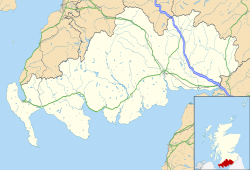
Location Image
2.9 km

Dumfries and Galloway

Dumfries and Galloway (Scots: Dumfries an Gallowa; Scottish Gaelic: Dùn Phrìs is Gall-Ghaidhealaibh) is one of the 32 unitary council areas of Scotland, situated in the western part of the Southern Uplands. It is bordered by East Ayrshire, South Ayrshire, and South Lanarkshire to the north; the Scottish Borders to the northeast; and the English county of Cumbria, the Solway Firth, and the Irish Sea to the south. To the west, it faces the North Channel. The administrative centre and largest settlement is the town of Dumfries. The second-largest town, Stranraer, lies approximately 76 miles (122 km) west of Dumfries on the North Channel coast. Dumfries and Galloway corresponds to the historic shire counties of Dumfriesshire, Kirkcudbrightshire, and Wigtownshire, the latter two collectively known as Galloway. These three counties were merged in 1975 to form the Dumfries and Galloway Region, which consisted of four districts. The district system was abolished in 1996, when the area became a single unitary authority under the same name. For lieutenancy purposes, Dumfries and Galloway is divided into three ceremonial areas: Dumfries, Wigtown, and the Stewartry of Kirkcudbright, each corresponding broadly to the former historic counties.
Location Image
6.0 km

Corsock

Corsock (Scottish Gaelic: Corsag) is a village in the historical county of Kirkcudbrightshire, Dumfries and Galloway, south-west Scotland. It is located 8 miles (13 km) north of Castle Douglas, and the same distance east of New Galloway, on the Urr Water. Corsock House is an 18th-century country house remodelled by David Bryce in 1853. A later addition was made by Charles Stuart Still Johnston in 1910. The gardens are open to the public under the Scotland's Garden Scheme each Spring. Corsock Church was built as a Free Church in 1851-52 by local architect William McCandlish. It was extended in 1912 with a Gothic stone arch and chancel by J.A. McGregor.
Location Image
6.2 km

Loch Skae

Loch Skae is a small, upland freshwater loch to the north of Blackcraig Hill, approximately 18 miles (29 km) west of Dumfries, Scotland, 0.5 mi (0.80 km) east of Loch Howie, and 1 mi (1.6 km) south of the A702. The loch is somewhat circular in shape with a maximum diameter of 0.25 mi (0.40 km) from north to south. It has an average depth of 9.5 ft (2.9 m) and is 35 ft (11 m) at its deepest point. The loch was surveyed on 29 July 1903 by James Murray as part of Sir John Murray's Bathymetrical Survey of Fresh-Water Lochs of Scotland 1897-1909.
Location Image
7.5 km

Loch Howie

Loch Howie is a small, narrow, upland freshwater loch on the north side of Blackcraig Hill, approximately 18 miles (29 km) west of Dumfries, Scotland. The loch trends from south-west to north-east and is 0.75 mi (1.21 km) long by approximately 0.25 mi (0.40 km) at its widest point. It has an average depth of 16 ft (4.9 m) and is 39 ft (12 m) at its deepest. The loch was surveyed on 23 July 1903 by James Murray as part of Sir John Murray's Bathymetrical Survey of Fresh-Water Lochs of Scotland 1897-1909. The loch is popular for fishing and is populated with perch, pike and roach.