

 English
 Français

Corsock
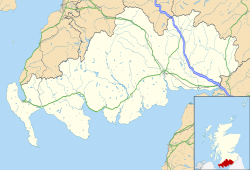
Corsock (Scottish Gaelic: Corsag) is a village in the historical county of Kirkcudbrightshire, Dumfries and Galloway, south-west Scotland. It is located 8 miles (13 km) north of Castle Douglas, and the same distance east of New Galloway, on the Urr Water. Corsock House is an 18th-century country house remodelled by David Bryce in 1853. A later addition was made by Charles Stuart Still Johnston in 1910. The gardens are open to the public under the Scotland's Garden Scheme each Spring. Corsock Church was built as a Free Church in 1851-52 by local architect William McCandlish. It was extended in 1912 with a Gothic stone arch and chancel by J.A. McGregor.
Nearby Places View Menu

4.2 km
Glenlair House
Glenlair, near the village of Corsock in the historical county of Kirkcudbrightshire, in Dumfries and Galloway, was the home of the physicist James Clerk Maxwell (1831–1879). The original structure was designed for Maxwell's father by Walter Newall; Maxwell himself oversaw the construction of an extension in the late 1860s, and further improvements were made by his heir, Andrew Wedderburn-Maxwell. A fire in 1929 left the house gutted, but a project to preserve and stabilise the remains has been undertaken by the Maxwell at Glenlair Trust.
4.6 km
Dumfries and Galloway
Dumfries and Galloway (Scots: Dumfries an Gallowa; Scottish Gaelic: Dùn Phrìs is Gall-Ghaidhealaibh) is one of the 32 unitary council areas of Scotland, situated in the western part of the Southern Uplands. It is bordered by East Ayrshire, South Ayrshire, and South Lanarkshire to the north; the Scottish Borders to the northeast; and the English county of Cumbria, the Solway Firth, and the Irish Sea to the south. To the west, it faces the North Channel.
The administrative centre and largest settlement is the town of Dumfries. The second-largest town, Stranraer, lies approximately 76 miles (122 km) west of Dumfries on the North Channel coast.
Dumfries and Galloway corresponds to the historic shire counties of Dumfriesshire, Kirkcudbrightshire, and Wigtownshire, the latter two collectively known as Galloway. These three counties were merged in 1975 to form the Dumfries and Galloway Region, which consisted of four districts. The district system was abolished in 1996, when the area became a single unitary authority under the same name.
For lieutenancy purposes, Dumfries and Galloway is divided into three ceremonial areas: Dumfries, Wigtown, and the Stewartry of Kirkcudbright, each corresponding broadly to the former historic counties.

6.0 km
Craigenputtock
Craigenputtock (usually spelled by the Carlyles as Craigenputtoch) is a farmhouse in Scotland where Thomas Carlyle lived from 1828 to 1834. He wrote several of his early works there, including Sartor Resartus.
The estate's name incorporates the Scots words craig, meaning hill, referring in this case to a whinstone hill, and puttock, or small hawk. Craigenputtock occupies 800 acres (320 hectares) of farmland in the civil parish of Dunscore in Dumfriesshire, within the District Council Region of Dumfries and Galloway. The dwelling on the grounds is a two-storey, four bedroomed Georgian Country House (category B listed). The plot also comprises two cottages, a farmstead, 315 acres (127 ha) of moorland hill rising to 1,000 ft (300 m) above sea level, and 350 acres (140 ha) of inbye ground of which 40 acres (16 ha) is arable, ploughable land and 135 acres (55 ha) is woodland.
It was the property for generations (circa 1500) of the family Welsh, and eventually that of their heiress, Jane Baillie Welsh Carlyle (1801–1866) (descended on the paternal side from Elizabeth, the youngest daughter of John Knox), which the Carlyles made their dwelling-house in 1828, where they remained for seven years (before moving to Carlyle's House in Cheyne Row, London), and where Sartor Resartus was written. The property was bequeathed by Thomas Carlyle to the Edinburgh University on his death in 1881.
It is certain that for living and thinking in, I have never since found in the world a place so favourable. How blessed might poor mortals be in the straitest circumstances if their wisdom and fidelity to heaven and to one another were adequately great!

6.1 km
Kilquhanity School
Kilquhanity School was one of several free schools to have been established in the United Kingdom in the twentieth century. Others include Sands School in Devon, Summerhill in Suffolk, Sherwood School in Epsom and Kirkdale School in London.
The school was founded by John Aitkenhead (1910-1998) and his wife Morag in 1940. It was closed in 1997. It was located in a classical mansion house designed by the architect Walter Newall near the town of Kirkpatrick Durham in the historical county of Kirkcudbrightshire in Galloway. The school was reopened under head teacher and former pupil Andrew Pyle, with the support of a Japanese educational organisation Kinokuni Children's Village Schools (headed by Shinichiro Hori) which now owns the premises. The first intake of 12 pupils was expected in 2013. A previous attempt to reopen in 2009 failed to attract a financially viable number of pupils.
The school was visited in 1941 by the refugee Polish Jewish artist Jankel Adler who had been evacuated to Glasgow. The poet W S Graham, who had earlier helped him translate an article on Paul Klee in Glasgow was working here at the time. He spent New Year 1942 here, Christopher Murray Grieve (Hugh MacDiarmid) whose son Michael was a pupil here, was also present.