

 English
 Français

Loch Skae
Loch Skae is a small, upland freshwater loch to the north of Blackcraig Hill, approximately 18 miles (29 km) west of Dumfries, Scotland, 0.5 mi (0.80 km) east of Loch Howie, and 1 mi (1.6 km) south of the A702. The loch is somewhat circular in shape with a maximum diameter of 0.25 mi (0.40 km) from north to south. It has an average depth of 9.5 ft (2.9 m) and is 35 ft (11 m) at its deepest point. The loch was surveyed on 29 July 1903 by James Murray as part of Sir John Murray's Bathymetrical Survey of Fresh-Water Lochs of Scotland 1897-1909.
Nearby Places View Menu

1.4 km
Loch Howie
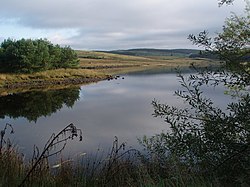
Loch Howie is a small, narrow, upland freshwater loch on the north side of Blackcraig Hill, approximately 18 miles (29 km) west of Dumfries, Scotland. The loch trends from south-west to north-east and is 0.75 mi (1.21 km) long by approximately 0.25 mi (0.40 km) at its widest point. It has an average depth of 16 ft (4.9 m) and is 39 ft (12 m) at its deepest. The loch was surveyed on 23 July 1903 by James Murray as part of Sir John Murray's Bathymetrical Survey of Fresh-Water Lochs of Scotland 1897-1909.
The loch is popular for fishing and is populated with perch, pike and roach.
5.3 km
Lochinvar
Lochinvar (or Lan Var) is a loch in the civil parish of Dalry in the historic county of Kirkcudbrightshire, Dumfries and Galloway Scotland. It is located in the Galloway Hills, around 3.5 miles (5.6 km) north-east of St. John's Town of Dalry. The loch formerly had an island on which stood Lochinvar Castle, seat of the Gordon family. In the 20th century the loch was dammed to form a reservoir, raising the water level and submerging the island with the ruins of the castle. The loch is used for trout fishing.
The name Lochinvar is from Scots Gaelic Loch a' bharra (older Gaelic Loch an bharra, the genitive of barr = summit) meaning "Loch on the hilltop". Consequently, it is stressed on the last syllable (unlike Lochinver).

5.9 km
Barscobe Castle
Barscobe Castle is a 17th-century tower house in Balmaclellan, Kirkcudbrightshire, Scotland. It is a typical house of a country laird, and according to a panel above the entrance, was built in 1648. The L-plan tower was constructed using stone taken from Threave Castle. Barscobe Castle is a category A listed building.

6.2 km
Craigenputtock
Craigenputtock (usually spelled by the Carlyles as Craigenputtoch) is a farmhouse in Scotland where Thomas Carlyle lived from 1828 to 1834. He wrote several of his early works there, including Sartor Resartus.
The estate's name incorporates the Scots words craig, meaning hill, referring in this case to a whinstone hill, and puttock, or small hawk. Craigenputtock occupies 800 acres (320 hectares) of farmland in the civil parish of Dunscore in Dumfriesshire, within the District Council Region of Dumfries and Galloway. The dwelling on the grounds is a two-storey, four bedroomed Georgian Country House (category B listed). The plot also comprises two cottages, a farmstead, 315 acres (127 ha) of moorland hill rising to 1,000 ft (300 m) above sea level, and 350 acres (140 ha) of inbye ground of which 40 acres (16 ha) is arable, ploughable land and 135 acres (55 ha) is woodland.
It was the property for generations (circa 1500) of the family Welsh, and eventually that of their heiress, Jane Baillie Welsh Carlyle (1801–1866) (descended on the paternal side from Elizabeth, the youngest daughter of John Knox), which the Carlyles made their dwelling-house in 1828, where they remained for seven years (before moving to Carlyle's House in Cheyne Row, London), and where Sartor Resartus was written. The property was bequeathed by Thomas Carlyle to the Edinburgh University on his death in 1881.
It is certain that for living and thinking in, I have never since found in the world a place so favourable. How blessed might poor mortals be in the straitest circumstances if their wisdom and fidelity to heaven and to one another were adequately great!