Mission Street est une artère nord-sud située à Daly City et San Francisco, en Californie.

1. Situation et accès

La rue s'étend de la frontière sud de Daly City jusqu'au front de mer nord-est de San Francisco. La rue et le quartier Mission de San Francisco qu'elle traverse doivent leur nom à la mission espagnole Dolores, située à quelques pâtés de maisons de la route moderne. Seule la moitié sud fait historiquement partie du Camino Real, qui reliait les missions. Une partie de Mission Street à Daly City est signalée comme faisant partie de la State Route 82 (SR 82). Depuis le sud, Mission Street débute dans le prolongement de la SR 82/El Camino Real à la frontière entre Colma et Daly City, juste au sud de San Pedro Road. Mission Street se dirige ensuite vers le nord jusqu'au quartier de Top of the Hill, où la SR 82 se divise en San Jose Avenue au nord-est, et Mission Street continue vers le nord-nord-est. Elle traverse ensuite les limites de la ville de San Francisco à mi-pâté de maisons entre Templeton Avenue à Daly City et Huron Avenue à San Francisco. Mission Street rebrousse ensuite chemin vers le nord-est en traversant les quartiers populaires de Crocker-Amazon, Excelsior et Bernal Heights, avant de bifurquer vers le nord à travers les quartiers colorés d'Outer Mission et d'Inner Mission. Près de Van Ness Avenue, la route bifurque à nouveau vers le nord-est et traverse Mid-Market et South of Market (parallèlement à Market Street et à un pâté de maisons au sud) avant de se terminer à l'The Embarcadero, dans le centre-ville de San Francisco.

1. = Transport =

La partie Mission Street à San Francisco est desservie 24 heures sur 24 par le trolleybus (Mission) du San Francisco Municipal Railway, deux stations BART qui passent sous le niveau du sol dans l'Inner Mission et le reste des stations BART de San Francisco à moins d'un demi-mile, notamment celles du métro de Market Street. La rue est large de quatre voies. Le centre de transit Salesforce (Transbay Transit Center), qui a remplacé le terminal Transbay, s'étend sur plusieurs pâtés de maisons entre Mission et Howard. C'est le terminus ouest de plusieurs lignes de bus AC Transit via le pont de la baie de San Francisco-Oakland (Bay Bridge), et ce sera le futur terminus nord de Caltrain et de la California High-Speed Rail Authority. Depuis l'achèvement du Bay Bridge en 1936 jusqu'aux années 1950, il s'agissait également du terminus ouest du service ferroviaire de banlieue Key System.

1. Origine du nom

La rue et le quartier tirent leur nom de la Mission Dolores, fondée en 1776 par des franciscains espagnols pour évangéliser les populations autochtones.

1. Historique

Mission Bay et Mission Dolores étaient reliées à l'ancien village de Yerba Buena, dans le coin nord-est de la ville moderne de San Francisco, via la Mission Plank Road, une route à péage de 3,25 milles (5,2 km) de long s'étendant de Kearny/Third à Fifteenth. La franchise pour la Mission Plank Road a été accordée en novembre 1850 et la Plank Road a été achevée au printemps suivant pour un coût de US$96 000 (équivalent à US$1 850 de 2024) ; les péages étaient de 50 cents pour un cheval et une charrette et d'un dollar pour un attelage de quatre chevaux. L'alignement de Mission a été choisi parce que Market avait une crête élevée entre les Second et Fifth rues ; bien qu'une coupe était toujours nécessaire pour Mission, elle était moins étendue. La Plank Road utilisait un pont pour traverser un marais à Mission et Seventh ; le pont était censé reposer sur des pieux, mais les pieux ont été enfoncés à 80 pieds (24,38 m) sans atteindre le fond, donc un pont flottant a été utilisé à la place. Une route parallèle en planches a été construite le long de Folsom Street pour éviter la concurrence potentielle d'une route gratuite le long de Market ; cependant, une marée haute en 1854 a détruit la Folsom Plank Road en faisant flotter les planches. Depuis 2000, entre Third Street et Beale Street dans le Financial District (quartier financier), plusieurs nouveaux gratte-ciel ont été érigés le long de Mission Street, tous à proximité du projet de développement San Francisco Transbay (San Francisco Transbay development) : 101 Second Street (2000), JPMorgan Chase Building (2002), The Paramount (2002), St. Regis Museum Tower (2005), 555 Mission Street (2008), Millennium Tower (2009), 535 Mission Street (2014), 350 Mission Street (2015), et la Salesforce Tower (2017).

1. Notes et références


1. = Notes =


1. = Références =


1. Liens externes

Portail de San Francisco Portail des routes

Nearby Places View Menu
Location Image
209 m

San Francisco Ferry Building

The San Francisco Ferry Building is a terminal for ferries that travel across the San Francisco Bay, a food hall and an office building. It is located on The Embarcadero in San Francisco, California and is served by Golden Gate Ferry and San Francisco Bay Ferry routes. On top of the building is a 245-foot-tall (75 m) clock tower with four clock dials, each 22 feet (6.7 m) in diameter, which can be seen from Market Street, a main thoroughfare of the city. Designed in 1892 by American architect A. Page Brown in the Beaux-Arts style, the ferry building was completed in 1898. At its opening, it was the largest project undertaken in the city up to that time. One of Brown's design inspirations for the clock tower may have been the current 16th-century iteration of the 12th-century Giralda bell tower in Seville, Spain. The entire length of the building on both frontages is based on an arched arcade. With decreased use since the 1950s, after bridges were constructed to carry transbay traffic and most streetcar routes were converted to buses, the building was adapted to office use and its public spaces broken up. In 2002, a restoration and renovation were undertaken to redevelop the entire complex. The 660-foot-long (200 m) Great Nave was restored, together with its height and materials. A marketplace was created on the ground floor, the former baggage handling area. The second and third floors were adapted for office and Port Commission use. On every hour during daylight, the clock bell chimes portions of the Westminster Quarters. The ferry terminal is a designated San Francisco landmark and is listed on the National Register of Historic Places.
Location Image
276 m

Abraham Lincoln Brigade Monument

The Abraham Lincoln Brigade Monument is a steel and onyx art installation in Embarcadero Plaza in San Francisco's Financial District, in the U.S. state of California. The Monument was designed by Ann Chamberlain and Walter J. Hood with US$400,000 in funding from the Abraham Lincoln Brigade Archives to honor the Lincoln Battalion and XV International Brigade, formed to fight for the Spanish Republic during the Spanish Civil War. It was dedicated on March 30, 2008 and is part of the San Francisco Arts Commission collection. One side of the monuments' panels show portraits of the volunteers. The other side of the panels contain annotated maps of the front lines between 1936 and 1938, as well as quotes of volunteers Abe Osheroff, Dave Smith, Alvah Bessie, Edwin Rolfe, Frederick Martin, Ruth Davidow, Robert Colodny, and Steve Nelson. The remainder panels contain words about that period from historians, labor organizers, writers, and musicians, such as Dolores Ibarruri, Albert Camus, Ernest Hemingway, and Paul Robeson. Intermittent repairs occurred in the decade since the Monument was installed. In August 2018, the onyx stone panels were removed and taken offsite for repair, due to a combination of design issues and neglect. The Monument was restored by May 2020.
Location Image
277 m

Vaillancourt Fountain

Vaillancourt Fountain, sometimes called Québec libre!, is a large fountain in Embarcadero Plaza in San Francisco, designed by the Québécois artist Armand Vaillancourt in collaboration with the plaza's landscape architect, Lawrence Halprin, and completed in 1971. It is about 40 feet (12 m) high and is constructed out of precast concrete square tubes. Long considered controversial because of its stark, modernist appearance, there have been several unsuccessful proposals to demolish the fountain over the years. It was the site of a free concert by U2 in 1987, when lead singer Bono spray painted graffiti on the fountain and was both praised and criticized for the action. The city determined the fountain to be a historic resource in 2025, and later voted to remove it citing concerns about structural deterioration.
Location Image
402 m

Sue Bierman Park

Sue Bierman Park, previously known as Ferry Park, is a 5.3-acre (2.1 ha) park in San Francisco, California in the Financial District, in the U.S. state of California. The park is named after Sue Bierman, a San Francisco civic activist and San Francisco Supervisor. It was completed in 1975 and is owned and operated by the San Francisco Recreation & Parks Department. Sue Bierman Park is bordered by Washington Street on the north, The Embarcadero on the east, a combination of Embarcadero Plaza and Clay Street on the south, and Davis Street on the west. Drumm Street cuts through the center of the park.
Location Image
416 m

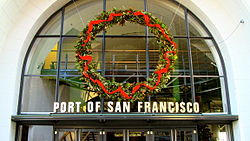
Port of San Francisco

The Port of San Francisco is a semi-independent organization that oversees the port facilities at San Francisco, California, United States. It is run by a five-member commission, appointed by the mayor subject to confirmation by a majority of the San Francisco Board of Supervisors. The Port is responsible for managing the larger waterfront area that extends from the anchorage of the Golden Gate Bridge, along the Marina district, all the way around the north and east shores of the city of San Francisco including Fisherman's Wharf and the Embarcadero, and southward to the city line just beyond Candlestick Point. In 1968, the State of California, via the California State Lands Commission for the state-operated San Francisco Port Authority (est. 1957), transferred its responsibilities for the Harbor of San Francisco waterfront to the City and County of San Francisco/San Francisco Harbor Commission through the Burton Act AB2649. All eligible state port authority employees had the option to become employees of the City and County of San Francisco to maintain consistent operation of the port of San Francisco. The port of San Francisco lies on the western edge of the San Francisco Bay near the Golden Gate. It has been called one of the three great natural harbors in the world, but it took two long centuries for navigators from Spain and England to find the anchorage originally called Yerba Buena: a port, as was said in its early days, in which all the fleets of the world could find anchorage. The port area under the commission's control comprises nearly eight miles of waterfront lands, commercial real estate and maritime piers from Hyde Street on the north to India Basin in the southeast. The list of landmarks under port control include Fisherman's Wharf, Pier 39, the Ferry Building, Oracle Park (formerly AT&T Park, SBC Park and Pacific Bell Park), located next to China Basin and Pier 70 at Potrero Point. Huge covered piers on piles jut out into San Francisco Bay along much of the waterfront, bordered by the Embarcadero roadway. In 2015, the city, acting through the port of San Francisco, launched the San Francisco Seawall Earthquake Safety and Disaster Prevention Program (Seawall Program).