Location Image

Barnum's American Museum

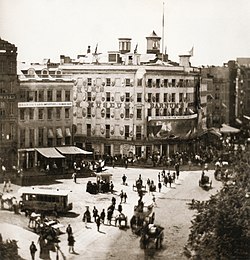
Le Barnum's American Museum est un musée localisé au carrefour de Broadway et d'Ann Street au XIXe siècle à New York. Il a été fondé en 1841 par le célèbre entrepreneur de spectacles P. T. Barnum, à la suite du rachat par ce dernier du Scudder's American Museum. Le musée de Barnum contenait de nombreuses attractions, comme une ménagerie d'animaux exotiques, un musée d'histoire naturelle, un musée de cire ou encore un cabinet de curiosités. Le musée opère une fusion des ethnic shows et des freaks shows.

1. Musée et mise en scène de l'étrange

La collection du musée comprend des objets collectés dans le monde entier sur une période de 25 ans combinant un divertissement sensationnel à travers les freaks show et des expositions d'histoire naturelle à des fins éducatives et artistiques.

1. = Public =

À travers cette acquisition, P. T. Barnum créé le premier lieu de divertissement démocratique de la ville. Convaincu que le grand public est attiré par des sujets controversés, il élargit les spectateurs allant des travailleurs pauvres et la classe moyenne montante de la fin du XIXème siècle. Précurseur de la publicité et de la promotion des spectacles, il attire les passants avec des cascades devant le bâtiment du musée et en ornant les côtés du bâtiment avec de grandes peintures d'animaux et d'autres attractions qui pourraient être trouvées à l'intérieur. Un prix d'entrée attractif (vingt-cinq cents) donnait droit à une journée au musée rendant accessible à l'ensemble des attractivités (expositions, spectacles...). Jusqu'à la guerre civile, les Afro-Américains étaient, sauf certains jours, interdits d'accès au musée, comme ils l'étaient la plupart des divertissements commerciaux d'avant-guerre à New York.

1. = « Science raciale » =

Parmi les personnes exhibées par P. T. Barnum figurent des Afro-Américains affectés de vitiligo, d'albinisme et de microcéphalie, présentés comme des « liens manquants » dans la chaîne de l’évolution, qui irait de homme singe au Noir pour arriver au Blanc. Ainsi selon le spécialiste de l'histoire culturelle américaine Benjamin Reiss, la « science raciale » de l'époque façonne ces représentations. Loin d'estomper les différences entre Blanc et Noir, ces types de spectacles consolident ces catégories : pour ce même auteur, «les « liens manquants » démontraient les implications racistes des nouvelles théories darwinienne».

1. = Fermeture =

En 1865, le musée est détruit par un incendie qui fut très médiatisé. Les images de l'événement firent le tour des journaux illustrés et des périodiques, et firent même l'objet d'œuvres d'art.

1. Postérité

Le musée de Barnum réunit le divertissement et la science ; il met en scène l’étrange, des danses ou des reconstitutions théâtrales, en même temps qu'il propose des conférences « scientifiques ». Il préfigure les exhibitions ethniques en Europe qui se tiennent soit de manière autonome, soit dans le cadre des expositions universelles (lors de l'Exposition universelle de Londres de 1851 et de la tournée des Zoulous de 1853), soit, dès 1883, dans des expositions coloniales. Ce phénomène, "industrialisé", donne naissance par la suite aux zoos humains.

1. Notes et références

Portail des musées Portail de l’anthropologie Portail du XIXe siècle Portail de New York

Nearby Places View Menu
Location Image
243 m

Singer Building

The Singer Building (also known as the Singer Tower) was an office building and early skyscraper at the northwestern corner of Liberty Street and Broadway in the Financial District of Lower Manhattan, New York City, United States. Serving as the headquarters of the Singer Manufacturing Company, it was commissioned by the company's leader Frederick Gilbert Bourne and designed by architect Ernest Flagg in multiple phases from 1897 to 1908. The building's architecture contained elements of the Beaux-Arts and French Second Empire styles. The building was composed of four distinct sections. The original 10-story Singer Building at 149 Broadway was erected between 1897 and 1898, and the adjoining 14-story Bourne Building on Liberty Street was built from 1898 to 1899. In the first decade of the 20th century, the two buildings were expanded to form the 14-story base of the Singer Tower, which rose another 27 stories. The facade was made of brick, stone, and terracotta. A dome with a lantern capped the tower. The foundation of the tower was excavated using caissons; the building's base rested on shallower foundations. The Singer Building used a steel frame, though load-bearing walls initially supported the original structure before modification. When completed, the 41-story building had a marble-clad entrance lobby, 16 elevators, 410,000 square feet (38,000 m2) of office space, and an observation deck. With a roof height of 612 feet (187 m), the Singer Tower surpassed Philadelphia City Hall to become the tallest building in the world from 1908 to 1909, when it was superseded by the Metropolitan Life Insurance Company Tower. The base occupied the building's entire land lot; the tower's floors took up just one-sixth of that area. Despite being regarded as a city icon, the Singer Building was razed between 1967 and 1969 to make way for One Liberty Plaza, which had several times more office space than the Singer Tower. At the time of its destruction, the Singer Building was the tallest building ever to be demolished by its owners, a distinction it held until 270 Park Avenue was demolished in 2019.
Location Image
243 m

One Liberty Plaza

One Liberty Plaza, formerly the U.S. Steel Building, is a skyscraper in the Financial District of Lower Manhattan in New York City. It is situated on a block bounded by Broadway, Liberty Street, Church Street, and Cortlandt Street, on the sites of the former Singer Building and City Investing Building. The building was designed in the International Style by Skidmore, Owings & Merrill and completed in 1973. It is 743 ft (226 m) tall and has 54 floors. At 2.3 million sq ft (210,000 m2), each floor offers almost 1 acre (0.40 ha) of office space, making it one of the largest office buildings in New York by usable interior space. Its facade is black, consisting of a structural steel frame. South of the building is Zuccotti Park, formerly called Liberty Plaza Park. One Liberty Plaza was originally commissioned by U.S. Steel, and also housed the headquarters of Merrill Lynch. Since 2001, One Liberty Plaza has been owned and operated by Brookfield Properties.
Location Image
249 m

Liberty Tower (Manhattan)

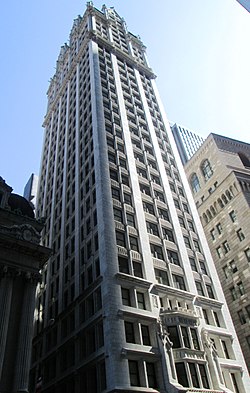
The Liberty Tower, formerly the Sinclair Oil Building, is a 33-story residential building in the Financial District of Manhattan in New York City. It is at 55 Liberty Street at the northwest corner with Nassau Street. It was built in 1909–10 as a commercial office building and was designed by Henry Ives Cobb in a Gothic Revival style. The site is adjacent to the New York Chamber of Commerce Building, while the Federal Reserve Bank of New York Building is to the east, across Nassau Street. Upon its completion, Liberty Tower was said to be the world's tallest building with such a small footprint, having a floor area ratio of 30 to 1. The building's articulation consists of three horizontal sections similar to the components of a column, namely a base, shaft, and capital. The limestone building is covered in white architectural terracotta with elaborate ornament. When the building opened in 1910, one of its first commercial tenants was the law office of future U.S. president Franklin Delano Roosevelt. Shortly after World War I, the entire building was bought by Sinclair Oil. In 1979, architect Joseph Pell Lombardi converted the building from commercial use into residential apartments and renamed it the "Liberty Tower", in one of the first such conversions in Manhattan south of Canal Street. The building was designated a city landmark by the New York City Landmarks Preservation Commission in 1982 and was added to the National Register of Historic Places (NRHP) in 1983. It is also a contributing property to the Wall Street Historic District, an NRHP district created in 2007.
Location Image
254 m

Double Check

Double Check is a 1982 sculpture by John Seward Johnson II, located across from Zuccotti Park at the corner of Liberty Street and Broadway in Manhattan, New York City. The bronze sculpture portrays a well-dressed businessman sitting with his briefcase open, which is filled with office materials getting ready to enter an office building. The statue is notable for its association with the 9/11 attacks.
Location Image
254 m

City Investing Building

The City Investing Building, also known as the Broadway–Cortlandt Building and the Benenson Building, was an office building and early skyscraper in Manhattan, New York. Serving as the headquarters of the City Investing Company, it was on Cortlandt Street between Church Street and Broadway in the Financial District of Lower Manhattan. The building was designed by Francis Kimball and constructed by the Hedden Construction Company. Because of the area's sloping topography, the City Investing Building rose 32 stories above Broadway and 33 stories above Church Street, excluding an attic. The bulk of the building was 26 stories high above Church Street and was capped by a seven-story central portion with gable roofs. The building had an asymmetrical F-shaped footprint with a light court facing Cortlandt Street, as well as a wing to Broadway that wrapped around a real estate holdout, the Gilsey Building. Inside was a massive lobby stretching between Broadway and Church Street. The upper stories each contained between 5,200 and 19,500 square feet (480 and 1,810 m2) of space on each floor. Work on the City Investing Building started in 1906, and it opened in 1908 with about 12 acres (49,000 m2; 520,000 ft2) of floor area, becoming one of New York City's largest office buildings at the time. Though developed by the City Investing Company, the structure had multiple owners throughout its existence. The City Investing Building was sold to the financier Grigori Benenson (1860–1939) in 1919 and renamed the Benenson Building. After Benenson was unable to pay the mortgage, it was sold twice in the 1930s. The building was renamed 165 Broadway by 1938 and was renovated in 1941. The City Investing Building and the adjacent Singer Building were razed in 1968 to make room for One Liberty Plaza, which had at least twice as much floor area as the two former buildings combined.