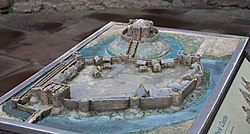
Le château d'York se situe dans la ville anglaise du même nom. Il s'agit d'un complexe fortifié dans lequel, au cours des neuf derniers siècles, se succédèrent châteaux, prisons, cours de justice et autres bâtiments, au sud de la rivière Foss. Le donjon du château médiéval normand, aujourd'hui en ruine, est parfois appelé Clifford's Tower, la tour de Clifford. Construit à l'origine sur ordre de Guillaume le Conquérant afin de dominer l'ancienne ville Viking d'York, le château subit un début d'histoire tumultueux avant de se développer pour devenir une fortification majeure possédant d'importants moyens hydrauliques pour se défendre. À la suite d'une grosse explosion en 1684 qui rendit impossible l'utilisation des ouvrages défensifs restants, le château d'York continua à servir de prison et ce jusqu'en 1929. La première forteresse élevée sur le site fut un château à motte construit en 1086 à la suite de la conquête normande de la ville. Après sa destruction par des insurgés et une armée Vikings en 1069, il fut reconstruit et renforcé, incluant dans son système de défense, une douve et un lac artificiel. Le château d'York constituait une fortification royale importante du nord de l'Angleterre. Henri III reconstruisit le château en pierre au milieu du XIIIe siècle, créant un donjon en quadrilobe unique, soutenu par un mur d'enceinte et un corps de garde. De 1298 à 1338, pendant les guerres d'indépendance de l'Écosse, le château d'York servit fréquemment de centre pour l'administration royale d'Angleterre et fut également une base importante pour les opérations militaires. Le château d'York tomba en ruine aux XVe et XVIe siècles, servant de plus en plus de prison à la fois pour les criminels locaux et les prisonniers politiques. Sous le règne d'Élisabeth Ire, on estima que le château avait perdu toute sa valeur militaire mais il fut maintenu comme centre de l'autorité royale d'York. En 1642, le déclenchement de la Première Révolution anglaise vit la réparation et la nouvelle fortification du château qui joua un rôle dans la défense des Cavaliers d'York en 1644 alors que ces derniers s'opposaient aux Têtes-Rondes. Des garnisons continuèrent d'être placées au château d'York jusqu'en 1684 lorsqu'une explosion détruisit l'intérieur de la tour Clifford. Le château à motte castrale fut remanié dans un style néoclassique au XVIIIe siècle pour devenir un centre administratif du comté du Yorkshire et fut utilisé comme prison notamment pour les débiteurs. Au XIXe siècle, la réforme des prisons conduisit en 1825 à la création sur le site du château d'une nouvelle prison construite dans le style gothique Tudor qui fut d'abord utilisée comme prison du comté puis comme prison militaire. Ces installations furent démolies en 1935. Au cours du XXe siècle, la tour Clifford en ruine était devenue une destination touristique connue et un monument national. Aujourd'hui, le site appartient à l'English Heritage, il est ouvert au public. Les bâtiments restants abritent le musée du château d'York et servent de Cour de la Couronne.

Nearby Places View Menu
Location Image
0 m

York Castle

York Castle is a fortified complex in the city of York, England. It consists of a sequence of castles, prisons, law courts and other buildings, which were built over the last nine centuries on the north-west side of the River Foss. The now ruined keep of the medieval Norman castle is commonly referred to as Clifford's Tower. Built originally on the orders of William I to dominate the former Viking city of Jórvík, the castle suffered a tumultuous early history before developing into a major fortification with extensive water defences. After a major explosion in 1684 rendered the remaining military defences uninhabitable, York Castle continued to be used as a jail and prison until 1929. The first motte and bailey castle on the site was built in 1068 following the Norman conquest of York. After the destruction of the castle by rebels and a Viking army in 1069, York Castle was rebuilt and reinforced with extensive water defences, including a moat and an artificial lake. York Castle formed an important royal fortification in the north of England. In 1190, 150 local Jews died in the timber castle keep; most of them committed suicide in order not to fall into the hands of the mob. In the middle of the 13th century, Henry III rebuilt the castle in stone creating a keep with a unique quatrefoil design, supported by an outer bailey wall and a substantial gatehouse. During the Scottish wars between 1298 and 1338, York Castle was frequently used as the centre of royal administration across England, as well as an important military base of operations. York Castle fell into disrepair by the 15th and 16th centuries, becoming used increasingly as a jail for both local felons and political prisoners. By the time of Elizabeth I the castle was estimated to have lost all of its military value but was maintained as a centre of royal authority in York. The outbreak of the English Civil War in 1642 saw York Castle being repaired and refortified, playing a part in the Royalist defence of York in 1644 against Parliamentary forces. York Castle continued to be garrisoned until 1684, when an explosion destroyed the interior of Clifford's Tower. The castle bailey was redeveloped in a neoclassical style in the 18th century as a centre for county administration in Yorkshire, and was used as a jail and debtors' prison. Prison reform in the 19th century led to the creation of a new prison built in a Tudor Gothic style on the castle site in 1825; used first as a county and then as a military prison, this facility was demolished in 1935. By the 20th century the ruin of Clifford's Tower had become a well-known tourist destination and national monument; today the site is owned by English Heritage and open to the public. The other remaining buildings serve as the York Castle Museum and the Crown Court.
Location Image
42 m

Tower Street (York)

Tower Street is a road in the city centre of York, in England.
Location Image
77 m

Tower Street drill hall, York

The Tower Street drill hall is a military installation on Tower Street, York. It is the Regimental Headquarters of the Royal Yorkshire Regiment. It is also home to the York Army Museum.
Location Image
88 m

York city walls

York has, since Roman times, been defended by walls of one form or another. To this day, substantial portions of the walls remain, and York has more miles of intact wall than any other city in England. They are known variously as York City Walls, the Bar Walls and the Roman walls (though this last is a misnomer as very little of the extant stonework is of Roman origin, and the course of the wall has been substantially altered since Roman times). The walls are generally 13 feet (4 m) high and 6 feet (1.8 m) wide. They are the longest town walls in England.
Location Image
89 m

York Debtor's Prison

York Debtor's Prison is a former debtor's prison and Grade I Listed building located in York, North Yorkshire. Since 1952 it has been part of the York Castle Museum.