

 English
 Français

Bamburgh
Bamburgh (/ˈbæmbrə/) est un village et une paroisse civile du Northumberland, en Angleterre. Il est situé sur la côte de la mer du Nord.
Nearby Places View Menu

13 m
Bamburgh
Bamburgh ( BAM-bər-ə) is a village and civil parish on the coast of Northumberland, England. It had a population of 454 in 2001, decreasing to 414 at the 2011 census.
Bamburgh was the centre of an independent north Northumbrian territory between 867 and 954. Bamburgh Castle was built by the Normans on the site of an Anglo-Saxon fort. The Victorian era heroine Grace Darling is buried there.
The extensive beach by the village was awarded the Blue Flag rural beach award in 2005. The Bamburgh Dunes, a Site of Special Scientific Interest, stand behind the beach. Bamburgh is popular with holidaymakers and is within the Northumberland Coast Area of Outstanding Natural Beauty.
481 m
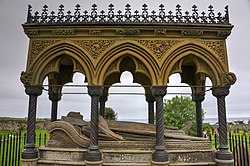
Monument to Grace Darling
The Monument to Grace Darling, in the churchyard of St Aidan's Church, Bamburgh, Northumberland is a Victorian Gothic memorial. The monument was designed by Anthony Salvin, with later renovations by Frederick Wilson, C. R. Smith and W. S. Hicks. Grace Darling was born on 24 November 1815, the daughter of the lighthouseman at Longstone Lighthouse. In 1838, Darling became a national heroine when she and her father rescued nine people from the wreck of the SS Forfarshire, a ship that had run aground off Big Harcar, an island off the Northumbrian coast. Darling died of tuberculosis aged 26 in 1842, and the monument was raised some distance to the north of her grave to make it visible to passing sailors, at the west edge of the churchyard in the same year. It is a Grade II* listed structure.

520 m
St Aidan's Church, Bamburgh
St Aidan's Church is a Grade I listed Church of England building in the Diocese of Newcastle.

866 m
Bamburgh Castle Lifeboat Station
Bamburgh Castle Lifeboat Station was located on The Wynding in Bamburgh, a village noted as the site of Bamburgh Castle, and also the burial place of Grace Darling, situated approximately 18 miles (29 km) south-east of Berwick-upon-Tweed, in the county of Northumberland.
A lifeboat was first placed at Bamburgh Castle by Lionel Lukin in 1786, and managed by the Crewe Trustees until 1824. A lifeboat station operated by the Royal National Lifeboat Institution (RNLI) was established in 1882.
After operating for just 15 years, Bamburgh Castle Lifeboat Station closed in 1897.
938 m
Bamburgh Sword
The Bamburgh Sword is an Anglo-Saxon artefact from the seventh century. It was uncovered during an archaeological excavation at Bamburgh Castle in 1960 by Brian Hope-Taylor. The sword was missing until his death in 2001, when it was found in a suitcase in his garage. It is unique amongst swords of its period, having been formed by six strands of iron pattern welded into a blade, resulting in speculation that it may have been the sword of a king.