

 English
 Français
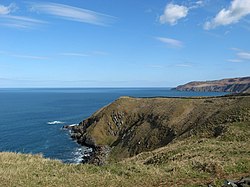
Siccar Point
Siccar Point est un promontoire rocheux situé sur la côte est de l'Écosse, dans le Berwickshire. Ce lieu est très connu pour abriter une importante discordance stratigraphique, découverte en 1788 par le géologue écossais James Hutton. Cette discordance très marquée, où des grauwackes verticaux du Silurien sont en contact direct avec des grès rouges subhorizontaux du Dévonien, permis à Hutton de démontrer que les processus géologiques étaient multiples et de comprendre que l'âge de la Terre était bien plus ancien que celui décrit dans la Bible. Depuis 1961, le site est classé comme « site d'intérêt scientifique spécial ».
Nearby Places View Menu
25 m
Siccar Point
Siccar Point is a rocky promontory in the county of Berwickshire on the east coast of Scotland.
It is famous in the history of geology for Hutton's Unconformity found in 1788, which James Hutton regarded as conclusive proof of his uniformitarian theory of geological development.

1.2 km
Battle of Piperdean
The Battle of Piperdean was an engagement in the Scottish Borders, fought on 10 September 1435 between the Kingdom of Scotland and the Kingdom of England.
An English force led by George de Dunbar, 11th Earl of March and Henry Percy, 2nd Earl of Northumberland attempted to take the forfeited Dunbar's Castle of Dunbar back from William Douglas, 2nd Earl of Angus, who as Warden of the Scottish Marches had invested the castle the previous summer. Percy and Dunbar came north with some 4,000 men.
Angus did not want to undergo a siege, and decided to pre-empt the English by attacking them en route. An army of roughly the same force surprised the English, under Angus, Adam Hepburn of Hailes, Alexander Elphinstone of that ilk, and Alexander Ramsay of Dalhousie.
Although an overwhelming Scots victory, there is some confusion as to casualties and prisoners taken. Ridpath states that the Scots lost 200 men including Elphinstone, with Brenan concurring about this 'trifling' amount,. The English suffered 1,500 fatalities, including 40 knights.
Northumberland retreated to Alnwick Castle, but it was not long before he returned to Scotland to relieve Roxburgh Castle, which was under siege by King James.

2.0 km
Pease Bay
Pease Bay is a bay situated around 9 miles southeast of Dunbar, in the Scottish Borders area of Scotland, close to the border with East Lothian as well as Cockburnspath, Cove and Dunglass. The area is notable as a holiday destination, for surfing in Scotland, and also for the large static caravan park at the bottom of the bay.

2.3 km
Pease Dean
Pease Dean is a nature reserve at Pease Bay, in the Scottish Borders area of Scotland, near the Anglo-Scottish border and Cockburnspath, Cove, and Dunglass. OS 67 NT794707.
The reserve is managed by the Scottish Wildlife Trust and has two parts: Pease Burn and Tower Burn. Pease Burn is open grassland, with gorse and alder. Tower Burn consists of mixed woodland.

2.7 km
Old Cambus
Old Cambus is a village in the Scottish Borders, Scotland. St. Helens church, which is now a ruin served the area.