

 English
 Français

Old Cambus
Old Cambus is a village in the Scottish Borders, Scotland. St. Helens church, which is now a ruin served the area.
Nearby Places View Menu
1.6 km
Penmanshiel Tunnel
Penmanshiel Tunnel is a now-disused railway tunnel near Grantshouse, Berwickshire, in the Scottish Borders region of Scotland. It was formerly part of the East Coast Main Line between Berwick-upon-Tweed and Dunbar.
The tunnel was constructed between 1845 and 1846 by contractors Ross and Mitchell, to a design by John Miller, who was the engineer to the North British Railway. Upon completion, the tunnel was inspected by the inspector-general of railways, Major-General Charles Pasley, on behalf of the Board of Trade.
The tunnel was 244 metres (267 yd) long, and carried two running lines in a single bore.
During its 134-year existence, the tunnel was the location of two incidents investigated by HM Railway Inspectorate. The first was in 1949, when a serious fire destroyed two carriages of a south-bound express from Edinburgh. Seven passengers were injured, but there were no deaths.
The second incident occurred on 17 March 1979 when, during improvement works, a length of the tunnel suddenly collapsed. Thirteen workers escaped, but two were killed. Later it was determined that it would be too dangerous and difficult to rebuild the tunnel, so it was sealed up and a new alignment was made for the railway, in a cutting to the west of the hill.
The tunnel was also affected by severe flooding in August 1948.

1.6 km
Battle of Piperdean
The Battle of Piperdean was an engagement in the Scottish Borders, fought on 10 September 1435 between the Kingdom of Scotland and the Kingdom of England.
An English force led by George de Dunbar, 11th Earl of March and Henry Percy, 2nd Earl of Northumberland attempted to take the forfeited Dunbar's Castle of Dunbar back from William Douglas, 2nd Earl of Angus, who as Warden of the Scottish Marches had invested the castle the previous summer. Percy and Dunbar came north with some 4,000 men.
Angus did not want to undergo a siege, and decided to pre-empt the English by attacking them en route. An army of roughly the same force surprised the English, under Angus, Adam Hepburn of Hailes, Alexander Elphinstone of that ilk, and Alexander Ramsay of Dalhousie.
Although an overwhelming Scots victory, there is some confusion as to casualties and prisoners taken. Ridpath states that the Scots lost 200 men including Elphinstone, with Brenan concurring about this 'trifling' amount,. The English suffered 1,500 fatalities, including 40 knights.
Northumberland retreated to Alnwick Castle, but it was not long before he returned to Scotland to relieve Roxburgh Castle, which was under siege by King James.

2.1 km
Pease Dean
Pease Dean is a nature reserve at Pease Bay, in the Scottish Borders area of Scotland, near the Anglo-Scottish border and Cockburnspath, Cove, and Dunglass. OS 67 NT794707.
The reserve is managed by the Scottish Wildlife Trust and has two parts: Pease Burn and Tower Burn. Pease Burn is open grassland, with gorse and alder. Tower Burn consists of mixed woodland.
2.7 km
Siccar Point
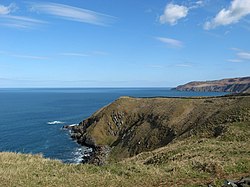
Siccar Point is a rocky promontory in the county of Berwickshire on the east coast of Scotland.
It is famous in the history of geology for Hutton's Unconformity found in 1788, which James Hutton regarded as conclusive proof of his uniformitarian theory of geological development.