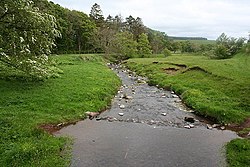
Barrow Meadow is a Site of Special Scientific Interest (SSSI) in north Northumberland, England. The site is a species-rich hay meadow of a sort now rare in Northumberland.

1. Location and natural features

Barrow Meadow is a field 4.9 hectares (12 acres) in area in the north-east of England in the county of Northumberland, some 0.4 miles (0.64 km) west-south-west of the village of Alwinton. The meadow is situated on flat land between the River Coquet and a southern tributary, the Barrow Burn, at their confluence some 150 metres (490 ft) above sea level. The surrounding terrain is hilly moorland. The meadow is judged to be species-rich in comparison with fields managed using contemporary farming methods involving the use of artificial fertilisers and reseeding. Aules Hill Meadows in the south-west and Barrow Burn Meadows in the north of the county are similarly protected hay meadows.

1. Vegetation

Barrow Meadow is a northern hay meadow characterised by the presence of a rich diversity of grasses, and an abundance of herbs. Grass species found at the site include sweet vernal-grass (Anthoxanthum odoratum), crested dog's-tail (Cynosurus cristatus), red fescue (Festuca rubra) and quaking grass (Briza media). Forbs include pignut (Conopodium majus), eyebright (Euphrasia agg.), meadow vetchling (Lathyrus pratensis), common knapweed (Centaurea nigra) and several species of lady's mantle (Alchemilla glabra), (A. xanthochlora) and (A. filicaulis). Other species found at the site include wood crane's-bill (Geranium sylvaticum), meadowsweet (Filipendula ulmaria), changing forget-me-not (Myosotis discolor), fairy flax (Linum catharticum), field wood-rush (Luzula campestris), betony (Stachys officinalis) and northern marsh-orchid (Dactylorhiza purpurella), as well as legumes, including meadow vetchling, bitter vetch (Lathyrus montanus), lesser trefoil (Trifolium dubium), red clover (T. pratense), white clover (T. repens), common and greater bird's-foot trefoils (Lotus corniculatus) and (L. uliginosus). The condition of Barrow Meadow was judged to be favourable in 2012.

1. Land ownership

Part of the land area designated as Barrow Meadow SSSI is owned by the Ministry of Defence

1. See also

List of Sites of Special Scientific Interest in Northumberland

1. References


1. External links

Natural England SSSI record for Barrow Meadow

Nearby Places View Menu
Location Image
600 m

Alwinton

Alwinton (previously named "Allenton" and sometimes still referred to as this) is a village and former parish in Northumberland, England. Alwinton is named after the nearby River Alwin, and means farm on the River Alwin. Alwinton lies at the head of the Coquet valley, on the edge of both the Otterburn Army Training Estate and the Northumberland National Park. The village is roughly 10 miles (16 km) from the border with Scotland, and about 18 miles (29 km) to the west of Alnwick. The neighbouring village of Harbottle and Harbottle Castle are about 2.5 kilometres (1.6 mi) from Alwinton. A road continues past Alwinton into the Cheviot Hills where it terminates at the ancient Roman military encampment of Chew Green. Having no shops, Alwinton's social life centres on the Rose and Thistle Inn, a public house owned by the Latchams. Regular Church of England services are offered at St. Michael and All Angels, which traditionally serves the parish of Alwinton encompassing the nearby townships of Biddlestone, Burradon, Clennell, Fairhaugh, Farnham, Linbriggs, Netherton, Peels, and Sharperton. In the early 21st century several of rural Northumberland's least populated parishes were merged into slightly larger units, and Alwinton was one example, being merged with the neighbouring Biddlestone (where from the Census 2011 the population is included).
Location Image
745 m

River Alwin

The River Alwin is a short, steep upland river that drains the Kidland Forest on the southern flanks of the Cheviot Hills, in the Northumberland National Park, England. It is a tributary of the River Coquet and 2.7 miles (4.3 km) in length.
Location Image
1.6 km

Clennell, Northumberland

Clennell is a small village and as Clennel, a former civil parish, now in the parish of Alwinton, in Northumberland, England. It is about 1 mile (1.6 km) north-east of Alwinton. In 1951 the parish had a population of 37.
Location Image
1.7 km

Clennell Hall

Clennell Hall is an historic manor house, now operated as a country hotel, situated at Clennell, near Alwinton, Northumberland, England. It is a Grade II listed building. The Clennell family held the manor of Clennell from the 13th century. In a survey of 1541 the tower house at Clennell was described as 'a little tower of Percival Clennell' then newly repaired with a barmkin under construction. In 1715 it was the seat of Luke Clennell, (High Sheriff of Northumberland in 1727) and comprised an old tower on the east, a double wing at the west and a small court to the south with a 'handsome gateway'. In 1749 Philadelphia Clennell, the heiress of the estate married William Wilkinson, (High Sheriff in 1758). In 1895 their great grandson Anthony Wilkinson greatly extended the property by the addition of a large Tudor style mansion. The present building incorporates a pele tower of 1589, much altered.