

 English
 Français

Bywell Hall
Bywell Hall is a privately owned 18th-century country house situated on the north bank of the River Tyne at Bywell, Northumberland, England. It is a Grade II* listed building.
Nearby Places View Menu

64 m
Bywell
Bywell is a village and civil parish in Northumberland, England. It is situated on the north bank of the River Tyne opposite Stocksfield, between Hexham and Newcastle. The parish has a population of around 380 and Newton to the north is now its most populous settlement.

192 m
St Andrew's Church, Bywell
St Andrew's Church is an Anglican church in the village of Bywell, Northumberland, England. It is recorded in the National Heritage List for England as a designated Grade I listed building, and is under the care of the Churches Conservation Trust.
420 m
Bywell Castle
Bywell Castle is situated in the village of Bywell overlooking the River Tyne, four miles east of Corbridge, Northumberland, England (grid reference NZ049615). It is a Grade I listed building and a Scheduled Ancient Monument.
It was built in 1430 by the Neville family (see Earl of Westmorland) but was never completed. The impressive three-storey gatehouse remains, together with part of a curtain wall into which has been incorporated a much later house (Grade II listed).
King Henry VI took refuge in Bywell Castle after the Battle of Hexham in 1464.
The Castle is privately owned and not normally open to visitors. It is the seat of the Viscounts Allendale.
Bywell Castle gave its name to a ship, which ploughed into the SS Princess Alice on the River Thames in September 1878, sinking her within minutes. The number of lives lost in the disaster are unclear but estimates have ranged from 590 to 640.
727 m
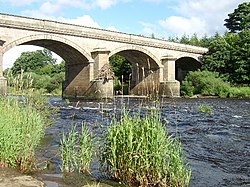
Bywell Bridge
Bywell Bridge is a 19th-century stone bridge across the River Tyne. It is a Grade II listed building.