

 English
 Français

Dottignies
Dottignies (en néerlandais Dottenijs, en picard Dot'gnie) est un village belge de la commune de Mouscron située dans la province de Hainaut en Wallonie picarde et en Flandre romane. Géographiquement, Dottignies fait partie de la Wallonie picarde.
Nearby Places View Menu

5.0 km
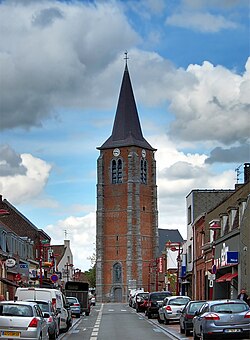
Luingne
Luingne ( LWEEN; French pronunciation: [lwin] or [lɥiɲ]; Dutch: Lowingen; Picard: Loinne) is a village of Wallonia and a district of the municipality of Mouscron, located in the province of Hainaut, Belgium.
It was a municipality in its own right before the 1977 fusion of municipalities. The inhabitants are called "Cleugnottes".
The district is 554-acre large.
5.5 km
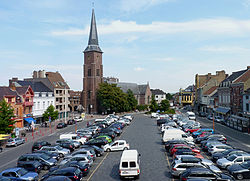
Leers
Leers (French pronunciation: [lɛʁs] , Dutch: [leːrs]) is a commune in the Nord department in northern France.
It is part of the Métropole Européenne de Lille, and is about 15 km (9.3 mi) northeast of Lille.
6.1 km
Mouscron
Mouscron (French pronunciation: [mukʁɔ̃] ; Dutch and West Flemish: Moeskroen, Dutch pronunciation: [muˈskrun] ; Picard and Walloon: Moucron) is a municipality and city of Wallonia located in the Belgian province of Hainaut, along the border with the French city of Tourcoing, which is part of the Lille metropolitan area.
The municipality consists of the following districts: Dottignies, Herseaux, Luingne, and Mouscron. In accordance with the national law, the municipality offers facilities for the Dutch speaking minority. Kortrijk, in Flanders, is located just to the north of Mouscron.
The city substantially grew during the 19th and early 20th century with the development of the textile industry in the north of France. The symbol of the city is the Hurlu: a character representing Protestant activists, who plundered the countryside during the Wars of Religion (16th century).

6.1 km
Battle of Mouscron
The Battle of Mouscron (28–29 April 1794) was a series of clashes that occurred when the Republican French Army of the North under Jean-Charles Pichegru moved northeast to attack Menin (now Menen) and was opposed by Coalition forces under the overall leadership of François Sébastien Charles Joseph de Croix, Count of Clerfayt. In their initial advance, the French began the siege of Menin and captured Courtrai (now Kortrijk). With Habsburg Austrian reinforcements, Clerfayt counterattacked on the 28th but Joseph Souham soon massed superior French forces and drove the Coalition troops out of the area. This Flanders Campaign action happened during the War of the First Coalition, part of the French Revolutionary Wars. The battle occurred near Mouscron, Belgium, located at the French border 9 kilometres (6 mi) south of Kortrijk and at Menen, located 11 kilometres (7 mi) west of Kortrijk.
Because most of the Coalition army was covering the Siege of Landrecies, the early French advance was largely successful in driving back a weak screen of Hanoverian troops. On the north bank of the Lys River, a division under Jean Victor Marie Moreau besieged Menen, while Souham's division operated on the south bank. Clerfayt's foray enjoyed initial success at Mouscron, but Souham on his own initiative concentrated superior forces against the Coalition. Completely isolated by Clerfayt's defeat, the largely Hanoverian garrison of Menin under Rudolf von Hammerstein broke out of the fortress and escaped on the 30th. The next action occurred at the Battle of Courtrai on 10 May.

6.1 km
Wattrelos
Wattrelos (French pronunciation: [watʁəlo] ; archaic Dutch: Waterlo) is a commune in the Nord department in the Hauts-de-France region of northern France. It is located on the border with Belgium, northeast of the city of Lille. The fifth-largest component of the Métropole Européenne de Lille, Wattrelos borders the communes of Roubaix, Tourcoing and Leers in France and the communes of Mouscron and Estaimpuis in Belgium.