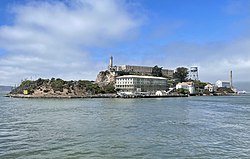
Alcatraz Island Lighthouse is a lighthouse—the first one built on the U.S. West Coast—located on Alcatraz Island in California's San Francisco Bay. It is located at the southern end of the island near the entrance to the prison. The first light house on the island was completed in 1854, and served the bay during its time as a Citadel and military prison. It was replaced by a taller (95 feet (29 m) above mean sea level) concrete tower built in 1909 to the south of the original one which was demolished after it was damaged due to earthquake in 1906. The automation of the lighthouse with a modern beacon took place in 1963, the year Alcatraz closed as the Alcatraz Federal Penitentiary. It is the oldest light station on the island with a modern beacon and is part of the museum on the island. Although when viewed from afar it easily looks the tallest structure on Alcatraz, it is actually shorter than the Alcatraz Water Tower, but as it lies on higher ground it looks much taller.

Nearby Places View Menu
Location Image
25 m

Warden's House (Alcatraz Island)

The Warden's House was the home of the wardens of the federal penitentiary on Alcatraz Island, off San Francisco. It is located at the southeastern end of the Main Cellblock, next to Alcatraz Lighthouse. The 3-floor 15-room mansion was built in 1921 according to the Golden Gate National Recreational Area signpost, although some sources say it was built in 1926 or 1929 and had 17 or 18 rooms. After Alcatraz was converted into a federal penitentiary, between 1934 and 1963 the four wardens of Alcatraz resided here including the first warden, James A. Johnston. A house of luxury in stark contrast to the jail next to it, the wardens often held lavish cocktail parties here. The signpost at the spot shows a photograph of a trusted inmate doing chores at the house for the warden and that the house had a terraced garden and greenhouse. The mansion had tall windows, providing fine views of San Francisco Bay. Today the house is a ruin, burnt during the AIM (American Indian Movement) Occupation of Alcatraz on June 1, 1970. AIM tried to put out the flames, but a bucket brigade was inadequate. The Warden's house had a greenhouse. Working there and getting access was a high mark of trust and approval for an inmate. The slope below the Warden's House has been the subject of structural remediation as it was deteriorating.
Location Image
56 m

Alcatraz Library

Alcatraz Library was a library for inmates at Alcatraz Federal Penitentiary. It was located at the end of D-Block. On entering Alcatraz, every inmate received a library card and a catalog of books found in the library. An inmate would order a book by putting a slip with their card in a box at the entrance to the dining hall before breakfast, and a librarian took the order to and from their cell. The library, which used a closed-stack paging system, had a collection of 10,000 to 15,000 books, mainly left over from Alcatraz's army days. Inmates were permitted a maximum of three books in addition to up to 12 text books, a Bible, and a dictionary. They were permitted to subscribe to magazines but crime-related pages were torn out and newspapers were prohibited. Crime and violence were prohibited from all books and magazines, and the library was governed by a chaplain who regulated the censorship and the nature of the reading material to ensure that the material was wholesome. Failure to return books by the date given made the inmate liable to removal of privileges. A sign in the library today displays an extract from the Federal Bureau of Prisons booklet in 1960: "These men read more serious literature than does the ordinary person in the community. Philosophers such as Kant, Schopenhauer, Hegel, etc. are especially popular." Other authors include Jack London, Sinclair Lewis, Washington Irving, Zane Grey, Hamlin Garland, Alexandre Dumas, Daniel Defoe, Joseph Conrad, Miguel de Cervantes and magazines such as Adventure to Time, Better Homes and Gardens and Library Digest. A law library was later added to A-Block. A library scene in Alcatraz appeared in the 1979 Clint Eastwood film Escape from Alcatraz in which Eastwood's character of Frank Morris converses with another inmate.
Location Image
64 m

Building 64

Building 64, also known as the Building #64 or the Building 64 Residential Apartments, was the first building constructed on the island of Alcatraz off the coast of San Francisco, USA, entirely for the purpose of accommodating the military officers and their families living on the island. Located next to the dock on the southeastern side of the island below the Warden's House, the three-story apartment block was built in 1905 on the site of a U.S. Army barracks which had been there from the 1860s. It functioned as the Military Guard Barracks from 1906 until 1933. One of its largest apartments in the southwest corner was known as the "Cow Palace" and a nearby alleyway was known as "Chinatown". During Federal prison times from 1934, the building gradually fell into a shabby state, and new quarters were built on the Parade Grounds, but most families arriving on the island stayed in Building 64 until a room in the newer quarters was available. Most of the other residential quarters have since been demolished, but Building 64 remains and has since been renovated. During the Occupation of Alcatraz, in 1970 the Native Americans drew graffiti in red around the "United States Penitentiary" sign saying "Indians welcome" and "Indian land". There is a book store on the ground floor on the left side of the building.
Location Image
71 m

Alcatraz Island

Alcatraz Island () is a small island about 1.25 miles offshore from San Francisco in San Francisco Bay, California, near the Golden Gate Strait. The island was developed in the mid-19th century with facilities for a lighthouse, a military fortification, and a military prison. In 1934, the island was converted into a federal prison, Alcatraz Federal Penitentiary. The strong tidal currents around the island and ice-cold water temperatures made escape nearly impossible, giving the prison one of the most notorious reputations of its kind in American history. The prison closed on March 21, 1963, leaving the island a major tourist attraction today with nearly 1.4 million people visiting the island annually. Beginning in November 1969, the island was occupied for more than 19 months by a group of Native Americans, initially primarily from San Francisco, who were later joined by the American Indian Movement and other urban Native Americans from other parts of the country, who were part of a wave of Native American activists organizing public protests across the US through the 1970s. In 1972, Alcatraz was transferred to the Department of Interior to become part of Golden Gate National Recreation Area. It was designated as a National Historic Landmark in 1986. Today, the island's facilities are managed by the National Park Service as part of Golden Gate National Recreation Area. Visitors can reach the island by ferry ride from Pier 33, located between the San Francisco Ferry Building and Fisherman's Wharf. Hornblower Cruises, operating under the name Alcatraz City Cruises, is the official ferry provider to and from the island. Alcatraz Island is the site of the abandoned federal prison, the oldest operating lighthouse on the West Coast of the United States, early military fortifications, and natural features such as rock pools and a seabird colony (mostly western gulls, cormorants, and egrets). According to a 1971 documentary on the history of Alcatraz, the island measures 1,675 feet (511 m) by 590 feet (180 m) and is 135 feet (41 m) at highest point during mean tide. The total area of the island is reported to be 22 acres (8.9 ha). Landmarks on the island include the Main Cellhouse, Dining Hall, Lighthouse, the ruins of the Warden's House and Social Hall, Parade Grounds, Building 64, Water Tower, New Industries Building, Model Industries Building, and the Recreation Yard.