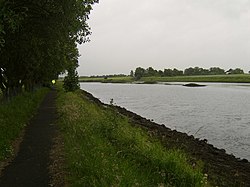
The River Cart is a tributary of the River Clyde, Scotland, which it joins from the west roughly midway between the towns of Erskine and Renfrew and opposite the town of Clydebank. The River Cart itself is very short, being formed from the confluence of the Black Cart Water (from the west) and the White Cart Water (from the south east) and is only 3⁄4 mile (1.2 kilometres) long. The River Cart and its tributary the White Cart Water were navigable as far as the Seedhill Craigs at Paisley; and, as with the River Clyde, various improvements were made to this river navigation. In 1840 the 1⁄2-mile (800-metre) Forth and Cart Canal was opened, linking the Forth and Clyde Canal, at Whitecrook near Clydebank, to the River Clyde, opposite the mouth of the River Cart. The aim was to provide a direct link between Paisley, Port Dundas, Edinburgh, and the Firth of Forth.

Nearby Places View Menu
Location Image
406 m

Blythswood House

Blythswood House was a 100-room neoclassical mansion at Renfrew, Scotland, built for the Douglas-Campbell family from the considerable incomes arising from their ownership of the Lands of Blythswood in Glasgow, including Blythswood Hill, developed initially by William Harley of Blythswood Square, and earlier lands surrounding Renfrew and Inchinnan. It was designed in 1821, by the architect James Gillespie Graham for Archibald Campbell, the Member of Parliament for the Glasgow District of Burghs. On his death in 1838 it passed to his second cousin Archibald Douglas Campbell (died 1868) of the lineage of Douglas of Mains, who adopted the name of Campbell, a pre-requisite of Blythswood ownerships. The house also contained a well-known laboratory that was used by Archibald Campbell, 1st Baron Blythswood from 1892 to 1905 to experiment into many areas at the borders of physics, including the use of cathode rays, X-rays, spectroscopy and radioactivity. The house remained the seat of the Lords Blythswood until its demolition in 1935. Five years later the family title became extinct.
Location Image
530 m

Renfrew Golf Club

Renfrew Golf Club is based in Renfrew, Scotland. It is situated in the Blythswood Estate, near to the River Cart and the River Clyde.
Location Image
662 m

Titan Clydebank

Titan Clydebank, more commonly known as the Titan Crane is a 161-foot-high (49 m) cantilever crane at Clydebank, West Dunbartonshire, Scotland. It was designed to be used in the lifting of heavy equipment, such as engines and boilers, during the fitting-out of battleships and ocean liners at the John Brown & Company shipyard. It was also the world's first electrically powered cantilever crane, and the largest crane of its type at the time of its completion. Situated at the end of a U-shaped fitting out basin, the crane was used to construct some of the largest ships of the 20th century, including the Queen Mary, Queen Elizabeth and Queen Elizabeth 2. The Category A Listed historical structure was refurbished in 2007 as a tourist attraction and shipbuilding museum. It is featured on the current Clydesdale Bank £5 note.
Location Image
676 m

Clydebank College

Clydebank College was a further education college in Clydebank, in West Dunbartonshire, Scotland. It is now part of the merged institution West College Scotland. Subjects offered for full-time study included: Administration and IT; Beauty Therapy; Coaching and Developing Sport; Computing - Technical Support; Early Education and Childcare; ESOL; Hairdressing; Media and Communication in the Creative Industries; Photography; Social Care; Travel and Tourism. There were also part-time courses available in some of these and in related subjects. The old college buildings at Kilbowie Road have been demolished and a new building was completed in August 2007 on the banks of the River Clyde, at the site of the former John Brown & Company Shipyard and Engineering Works. The current building is on three floors and is very elongated. The library is at one end of the 'grey mile' and the canteen is at the other. Clydebank College was part of the regeneration of West Dunbartonshire, with a 6-acre campus on the banks of the River Clyde.