Location Image

Titan Clydebank

Titan Clydebank, more commonly known as the Titan Crane is a 161-foot-high (49 m) cantilever crane at Clydebank, West Dunbartonshire, Scotland. It was designed to be used in the lifting of heavy equipment, such as engines and boilers, during the fitting-out of battleships and ocean liners at the John Brown & Company shipyard. It was also the world's first electrically powered cantilever crane, and the largest crane of its type at the time of its completion. Situated at the end of a U-shaped fitting out basin, the crane was used to construct some of the largest ships of the 20th century, including the Queen Mary, Queen Elizabeth and Queen Elizabeth 2. The Category A Listed historical structure was refurbished in 2007 as a tourist attraction and shipbuilding museum. It is featured on the current Clydesdale Bank £5 note.

Nearby Places View Menu
Location Image
258 m

Clydebank College

Clydebank College was a further education college in Clydebank, in West Dunbartonshire, Scotland. It is now part of the merged institution West College Scotland. Subjects offered for full-time study included: Administration and IT; Beauty Therapy; Coaching and Developing Sport; Computing - Technical Support; Early Education and Childcare; ESOL; Hairdressing; Media and Communication in the Creative Industries; Photography; Social Care; Travel and Tourism. There were also part-time courses available in some of these and in related subjects. The old college buildings at Kilbowie Road have been demolished and a new building was completed in August 2007 on the banks of the River Clyde, at the site of the former John Brown & Company Shipyard and Engineering Works. The current building is on three floors and is very elongated. The library is at one end of the 'grey mile' and the canteen is at the other. Clydebank College was part of the regeneration of West Dunbartonshire, with a 6-acre campus on the banks of the River Clyde.
Location Image
260 m

John Brown & Company

John Brown and Company of Clydebank was a Scottish marine engineering and shipbuilding firm. It built many notable and world-famous ships including RMS Lusitania, RMS Aquitania, HMS Hood, HMS Repulse, RMS Queen Mary, RMS Queen Elizabeth and Queen Elizabeth 2. At its height, from 1900 to the 1950s, it was one of the most highly regarded, and internationally famous, shipbuilding companies in the world. However thereafter, along with other UK shipbuilders, John Brown's found it increasingly difficult to compete with the emerging shipyards in Eastern Europe and the far East. In 1968 John Brown's merged with other Clydeside shipyards to form the Upper Clyde Shipbuilders consortium, but that collapsed in 1971. The company exited from shipbuilding but its engineering arm remained successful in the manufacture of industrial gas turbines. In 1986 it became a wholly owned subsidiary of Trafalgar House, which in 1996 was taken over by Kvaerner. The latter closed the Clydebank engineering works in 2000. Marathon Manufacturing Company bought the Clydebank shipyard from UCS and used it to build oil rig platforms for the North Sea oil industry. Union Industrielle d'Entreprise (UIE) (part of the French Bouygues group) bought the yard in 1980 and closed it in 2001.
Location Image
368 m

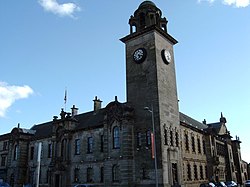
Clydebank Town Hall

Clydebank Town Hall is a municipal building in Dumbarton Road, Clydebank, Scotland. The town hall, which was the headquarters of Clydebank Burgh Council, is a Category B listed building.
Location Image
413 m

Morison Memorial church

Morison Memorial United Reformed Church is a church in Clydebank, Scotland. It is situated on Dumbarton Road near Clydebank Town Hall. Initial plans were drawn up in 1893. The church was designed by Glasgow architects, Steel & Balfour, in the English Gothic style and the foundation stone was laid by John Wilson, MP for Govan, on 3 October 1896. Morison has survived over 100 years including the Clydebank Blitz during World War II. The church was founded as an Evangelical Union church but soon became part of the Congregational Union of Scotland. In April 2000 the Congregational Union of Scotland united with the United Reformed Church creating a church in three nations.