Location Image

Blythswood House

Blythswood House was a 100-room neoclassical mansion at Renfrew, Scotland, built for the Douglas-Campbell family from the considerable incomes arising from their ownership of the Lands of Blythswood in Glasgow, including Blythswood Hill, developed initially by William Harley of Blythswood Square, and earlier lands surrounding Renfrew and Inchinnan. It was designed in 1821, by the architect James Gillespie Graham for Archibald Campbell, the Member of Parliament for the Glasgow District of Burghs. On his death in 1838 it passed to his second cousin Archibald Douglas Campbell (died 1868) of the lineage of Douglas of Mains, who adopted the name of Campbell, a pre-requisite of Blythswood ownerships. The house also contained a well-known laboratory that was used by Archibald Campbell, 1st Baron Blythswood from 1892 to 1905 to experiment into many areas at the borders of physics, including the use of cathode rays, X-rays, spectroscopy and radioactivity. The house remained the seat of the Lords Blythswood until its demolition in 1935. Five years later the family title became extinct.

Nearby Places View Menu
Location Image
136 m

Renfrew Golf Club

Renfrew Golf Club is based in Renfrew, Scotland. It is situated in the Blythswood Estate, near to the River Cart and the River Clyde.
Location Image
406 m

River Cart

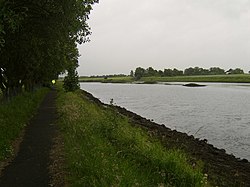
The River Cart is a tributary of the River Clyde, Scotland, which it joins from the west roughly midway between the towns of Erskine and Renfrew and opposite the town of Clydebank. The River Cart itself is very short, being formed from the confluence of the Black Cart Water (from the west) and the White Cart Water (from the south east) and is only 3⁄4 mile (1.2 kilometres) long. The River Cart and its tributary the White Cart Water were navigable as far as the Seedhill Craigs at Paisley; and, as with the River Clyde, various improvements were made to this river navigation. In 1840 the 1⁄2-mile (800-metre) Forth and Cart Canal was opened, linking the Forth and Clyde Canal, at Whitecrook near Clydebank, to the River Clyde, opposite the mouth of the River Cart. The aim was to provide a direct link between Paisley, Port Dundas, Edinburgh, and the Firth of Forth.
Location Image
779 m

Clydebank F.C.

Clydebank Football Club are a Scottish football club based in the town of Clydebank, West Dunbartonshire. Formed in 2003, they are currently a member of the Lowland League. The current Clydebank are a phoenix club formed after the previous Clydebank were bought out by Airdrieonians F.C. and moved to Airdrie. Supporters currently fund the club.
Location Image
797 m

Yoker Athletic F.C.

Yoker Athletic Football Club are a Scottish football club based in Clydebank near Glasgow. Yoker is an area of Glasgow adjacent to Clydebank, however Yoker's stadium lies just outside the Glasgow boundary. Nicknamed the Whe Ho, the club were formed in 1886 and are based at Holm Park. The club currently operate in the West of Scotland League Third Division and play in royal blue or orange strips. Local rivals Clydebank entered the Junior grade in 2003–04 and ground shared with Yoker at Holm Park from 2008 until 2018 after leaving their ground in Duntocher. Yoker were promoted to Central Division One on 23 April 2011 after an 8–0 victory over Newmains United. The team was co-managed since January 2019 by Peter McKenna and Tommy Montgomery, Gordon Robertson took over as manager in 2022 but has since been replaced by Dominic O'Donnell and Paul Brown. Yoker Athletic can boast of a mention in Scottish literature and film; James Kelman's novel, A Disaffection, has the main character attending a match at Holm Park, while the club is also mentioned briefly in an episode of Scottish cult classic Limmy's Show.