

 English
 Français
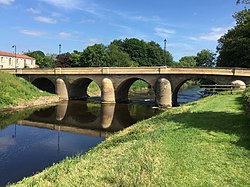
Tadcaster Bridge or Wharfe Bridge spans the River Wharfe in Tadcaster, North Yorkshire, England. The road bridge is believed to date from around 1700. It is the main route connecting the two sides of the town and one of two road crossings in the town, the other being the bridge for the A64 bypass. Tadcaster Bridge partially collapsed on 29 December 2015 after flooding that followed Storm Eva, and reopened on 3 February 2017.
Nearby Places View Menu

10 m
Ainsty Bounds Walk
The Ainsty Bounds Walk is a 44-mile (71 km) long-distance footpath mostly in North Yorkshire, England, with a short section in West Yorkshire. It follows the boundaries of the ancient wapentake of The Ainsty, between the rivers Wharfe, Nidd and Ouse, and passes through the towns of Boston Spa, Wetherby, Moor Monkton, the outskirts of York, and Bolton Percy. As a circular walk it can be walked from any point, but it is considered to start and finish at Tadcaster.

142 m
Tadcaster
Tadcaster is a market town and civil parish in North Yorkshire, England, 15 miles (24 km) north-east of Leeds and 10 miles (16 km) south-west of York.
Its historical importance from Roman times onward was largely as the lowest road crossing-point on the River Wharfe until the construction of the A64 Tadcaster by-pass some 660 yards (600 m) to the south, in 1978. There are two rail crossings downstream of the town before the Wharfe joins the River Ouse near Cawood. Thanks to its position on the banks of the River Wharfe parts of the town adjacent to the bridge are prone to flooding.
The town was part of the West Riding of Yorkshire until 1974, but is now part of North Yorkshire. Tadcaster is twinned with Saint-Chély-d'Apcher in France.
142 m
Battle of Tadcaster
The Battle of Tadcaster took place during the First English Civil War on 7 December 1642, when a Royalist force attacked the Parliamentarian garrison of Tadcaster, Yorkshire, which was held by between 900 and 1,500 soldiers under the command of Ferdinando Fairfax, Lord Fairfax. The Earl of Newcastle marched out of York on 6 December, and split his force of 6,000 into two; he took 4,000 infantry down the main York–Tadcaster road to attack the town from the east, while sending a deputy, the Earl of Newport, with a further 1,500 to circle around and trap the Parliamentarians by attacking from the north-west.
Newcastle's infantry engaged the town on the morning of 7 December, but after some initial minor incursions, the battle settled into an exchange of musket fire. Newport's detachment never joined the battle. Fairfax was nevertheless forced to retreat overnight, as he was running short of gunpowder, and Newcastle occupied the town the following day. He subsequently garrisoned a number of nearby towns, and cut Fairfax off from the West Riding of Yorkshire.

151 m
The Angel and White Horse
The Angel and White Horse is a pub in the town centre of Tadcaster, in North Yorkshire, in England.
In the Tudor period, The Red Hart inn lay on Bridge Street in Tadcaster. By the Georgian period, it had been rebuilt as The Angel, a coaching inn. In 1855, Albert Denison, 1st Baron Londesborough, purchased the building as part of a deal to establish a hotel next door, in the former White Horse inn. He closed The Angel, and converted it into shops.
Samuel Smith Old Brewery lies behind the building. It purchased the building and converted it into its brewery tap, opening in 1977. Its name recalls both the former coaching inn and its neighbour. By the early 21st century, the pub was recognised for its food, and in the early 2010s, it was listed in the Good Beer Guide. The building was Grade II listed in 1985.
The building is constructed of limestone, with some timber framing and brick. It is three storeys high, and six bays wide, with the fifth bay housing a carriage arch, and two bays having canted fronts. It retains some Tudor material, but is principally 18th century. It has mostly sash windows, and has a moulded cornice. The lower part of the three left-hand bays has been restored, and the lower part of the other bays has been partly rebuilt. There are late 20th century additions at the rear, and the entrance is also 20th century.
As of 2025, the pub is currently closed and Samuel Smiths Old Brewery are seeking managers to run it.