

 English
 Français

Cantsfield
Cantsfield is a hamlet and civil parish in the City of Lancaster, in Lancashire, England, near the boundary with North Yorkshire. It is situated near the River Greta and on the A687 road near the junction with the A683. The parish had a population of 76 according to the 2001 census. In the 2011 census the parish was included with Tunstall. The village is a designated conservation area. Thurland Castle, situated between Cantsfield and Tunstall, was originally built in the 14th century, and after being damaged during the English Civil War and rebuilt on two occasions, has now been converted into apartments.
1. See also
Listed buildings in Cantsfield
1. References


1. External links
Media related to Cantsfield at Wikimedia Commons
Nearby Places View Menu
1.1 km
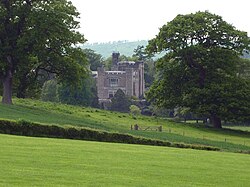
Thurland Castle
Thurland Castle is a country house in Lancashire, England, which has been converted into apartments. Surrounded by a moat, and located in parkland, it was originally a defensive structure, one of a number of castles in the Lune Valley. It is recorded in the National Heritage List for England as a designated Grade II* listed building. Situated between the villages of Cantsfield and Tunstall, the castle is built on a mound and is encircled by a moat. The River Greta runs to the south and the Cant beck to the north.

1.3 km
St John the Baptist's Church, Tunstall
St John the Baptist Church is located to the northeast of the village of Tunstall, Lancashire, England. It is an active Anglican parish church in the united benefice of East Lonsdale, in the deanery of Tunstall, the archdeaconry of Lancaster and the diocese of Blackburn. The benefice of East Lonsdale combines this church with St Peter, Leck, St Wilfrid, Melling, St James the Less, Tatham, The Good Shepherd, Lowgill, and Holy Trinity, Wray. The church is recorded in the National Heritage List for England as a designated Grade I listed building. Services are usually at 11:00 on 2nd & 4th Sundays, in rota with the sister church at Leck.

1.4 km
Tunstall, Lancashire
Tunstall is a village in north Lancashire, England (grid reference SD607736). It is 11.1 miles (18 km) northeast of Lancaster on the A683 road between Lancaster and Kirkby Lonsdale. In the 2001 census the civil parish of Tunstall had a population of 105. In the 2011 census Tunstall was grouped with Cantsfield (2001 pop. 76) to give a total of 223.
To the north east of the village is the Grade I listed Church of St John the Baptist.
Several houses, a restaurant, a village hall, and a tennis court make up most of the village of Tunstall. The restaurant/pub, called the Lunesdale Arms hosts many village activities, such as carol services and quizzes.
To the south of the village is Thurland Castle, which dates from the fourteenth century. It was made ruinous following a siege in 1643, restored in 1809 and 1829, then gutted by fire in 1879 and rebuilt. It is now divided into apartments.

2.2 km
Leck Beck
Leck Beck is a watercourse in Lancashire with its source on Crag Hill in Cumbria between Leck Fell and Casterton Fell.
For several kilometres near the start of its course, the water flows into the Ease Gill Cave System, part of The Three Counties System, the longest cave system in Britain (and 26th longest in the world) via 14 major sink holes, to resurge at a major spring at Leck Beck Head.
The rising of Leck Beck Head SD660 800 was dived extensively in the 1980s and required underwater digging and the use of an air chisel to make progress. The overflow for this rising, Witches Cave (Yorkshire), has been dived through a 300m sump into Witches II. A dry entrance was dug into Witches II from the surface in 2010.
The Beck flows through Leck, Cowan Bridge and Overtown before joining the River Lune near Nether Burrow.