Location Image

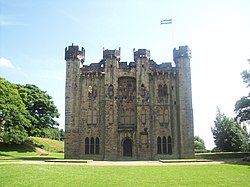
Château de Hylton

Le château de Hylton est un château en pierre, actuellement en ruine, situé près de Sunderland dans le Tyne and Wear en Angleterre. Construit à l'origine en bois, par un des baron Hylton, juste après la conquête normande de l'Angleterre. Il est reconstruit en pierre de la fin du XIVe jusqu'au début du XVe siècle. Le château a ensuite subi d'importantes modifications aux XVIIIe et XIXe siècles. Il sert divers usages après la fin de la maison Hylton en 1746, le bâtiment a été négligé puis est devenu une école en 1840, avant appartenir à une société houillère au XXe siècle, pour enfin être pris en charge par l'État en 1950, pour enfin appartenir aujourd'hui à l'English Heritage, organisme public chargé du patrimoine historique. Le château est réputé hanté par le Cauld Lad of Hylton.

Nearby Places View Menu
Location Image
0 m

Hylton Castle

Hylton Castle ( HIL-tən) is a stone castle in the North Hylton area of Sunderland, Tyne and Wear, England. Originally built from wood by the Hilton (later Hylton) family shortly after the Norman Conquest in 1066, it was later rebuilt in stone in the late 14th to early 15th century. The castle underwent major changes to its interior and exterior in the 18th century and it remained the principal seat of the Hylton family until the death of the last Baron in 1746. It was then Gothicised but neglected until 1812, when it was revitalised by a new owner. Standing empty again until the 1840s, it was briefly used as a school until it was purchased again in 1862. The site passed to a local coal company in the early 20th century and was taken over by the state in 1950. One of the castle's main features is the range of heraldic devices found mainly on the west façade, which have been retained from the castle's original construction. They depict the coats of arms belonging to local gentry and peers of the late 14th to early 15th centuries and provide an approximate date of the castle's reconstruction from wood to stone. The castle is owned by English Heritage, a charity which manages the historical environment of England. The surrounding parkland is maintained by a community organisation. The castle and its chapel are protected as a Grade I listed building and a scheduled monument. In February 2016, plans were announced to turn the castle into a community facility and visitor attraction, with the Heritage Lottery Fund awarding £2.9 million, and Sunderland Council £1.5 million, to provide classrooms, a cafe and rooms for exhibitions, meetings and events.
Location Image
215 m

Hylton Castle (suburb)

Hylton Castle is a suburb of Sunderland, Tyne and Wear, England. It is named after the nearby Hylton Castle.
Location Image
841 m

North Hylton

North Hylton is a suburb of Sunderland, Tyne and Wear, in northeast England. It is on the north bank of River Wear opposite South Hylton. Hylton Castle is in North Hylton. The settlement developed in the 14th century around the river crossing which was operated by the Lords of Hilton. By the 18th century industries such as shipbuilding contributed to population growth resulting in an 1871 Census return of almost 500. The area is the subject of the painting A Breezy Day, North Hylton by Richard A Ray.
Location Image
856 m

Castletown, Sunderland

Castletown is a suburb of Sunderland in Tyne and Wear, England. A former mining community, the Hylton Colliery was located at the east end of the village; it lies north of the River Wear, and is near to Hylton Castle and Washington. At Hylton Riverside, on the eastern fringe of Castletown, there is a large retail park. There is a large-scale redevelopment project, aimed at modernising the former pit houses and the area around the Aviary Estate. Since 2011 there have been further developments in the east part of the village. The Aviary area has been completely demolished and a new housing estate has replaced both sides of the main street. This site was re-developed by the Gentoo Group. At the opposite end of Castletown is the newer development of Fulford Grange. Castletown also hosts a luxury living estate named The Grove, where some of the current Sunderland AFC footballers live, including Granit Xhaka and Billy Hardy's nephew, Samuel Jordan. Currently, the records state that Castletown is the least ethnically diverse area in Sunderland, with 99.3% of the population being white. Despite its proximity to Sunderland, until 1967 this colliery village was under the administrative control of Durham County Council and was part of the Sunderland Rural District Council. This was because it was a fairly isolated community until the extensive council house building of the fifties and sixties at the Red House, Hylton Castle and Town end Farm Estates effectively joining the settlement to the rest of Sunderland's new northern suburbs. The Northern Spire Bridge, joining Castletown to Pallion, opened in August 2018. During the search for the Yorkshire Ripper, the accent of "Wearside Jack", the author of a hoax letter claiming to be from the Ripper, was identified by the forensic linguist Stanley Ellis as that of the Castletown area. The hoaxer was eventually revealed to have come from nearby Pennywell.
945 m

Hylton Colliery

Hylton Colliery, also known as Castletown Colliery, was a coal mine situated in Castletown, Sunderland. It was opened in 1900 and owned by Wearmouth Coal Company until 1947, after which it was taken over by the National Coal Board. It closed on 13 July 1979. The miners at the colliery ran a cricket club, now known as Hylton Cricket Club. Its football club, Hylton Colliery Welfare, played in the Wearside League, and included players such as Augie Scott and Ernie Taylor. Its junior team featured future Sunderland and West Ham United players Harry Hooper and Bill Robinson.