Location Image

Château de Cholmondeley

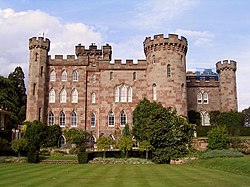
Château Cholmondeley est un château anglais dans la paroisse civile de Cholmondeley, Cheshire, Angleterre. Avec ses jardins à la française adjacents, il est entouré d'un parc. Le site de la maison est le siège de la famille Cholmondeley depuis le XIIe siècle. La maison actuelle remplace une halle à pans de bois située à proximité. Il est construit au début du XIXe siècle pour George Cholmondeley (1er marquis de Cholmondeley), qui en conçoit la majeure partie lui-même sous la forme d'un château crénelé. Après la mort du marquis, la maison est agrandie selon les plans de Robert Smirke pour produire le bâtiment dans sa forme actuelle. La maison est classée par English Heritage comme Immeuble classé II*. Le premier jardin à la française est conçu au XVIIe siècle par George London. À la suite de l'abandon au XVIIIe siècle, le jardin est réaménagé par William Emes, qui créé également le parc paysager. Au cours du XXe siècle, le jardin est développé par Lavinia, veuve du 6e marquis. Le parc et les jardins sont classés Grade II au Registre des Parcs et Jardins Historiques. Dans le parc et les jardins se trouvent un certain nombre d'autres bâtiments classés. Le plus important d'entre eux est la chapelle Saint-Nicolas, qui date du XIIIe siècle et contient beaucoup de mobilier du XVIIe siècle. Il est classé Grade I dans la liste du patrimoine national pour l'Angleterre. De l'autre côté de l'allée principale se trouve un écran et une passerelle en fer forgé fabriqués par Robert Bakewell en 1722 pour l'ancien manoir et déplacés là au début du XIXe siècle et classé comme Grade II*. Pendant la Seconde Guerre mondiale, la maison et le terrain sont utilisés à diverses fins militaires, dont un hôpital. Jusqu'à sa mort en novembre 2015, la maison est occupée par Lavinia, marquise douairière de Cholmondeley, mère de l'actuel marquis qui vit dans l'autre siège familial, Houghton Hall dans le Norfolk. La maison n'est pas ouverte au public, mais le parc et les jardins sont ouverts pendant la saison estivale.

Nearby Places View Menu
Location Image
19 m

Cholmondeley Castle

Cholmondeley Castle is a country house in the civil parish of Cholmondeley, Cheshire, England. Together with its adjacent formal gardens, it is surrounded by parkland. The site of the house has been a seat of the Cholmondeley family since the 12th century. The present house replaced a timber-framed hall nearby. It was built at the start of the 19th century for George Cholmondeley, 1st Marquess of Cholmondeley, who designed most of it himself in the form of a crenellated castle. After the death of the Marquess, the house was extended to designs by Robert Smirke to produce the building in its present form. The house is designated by English Heritage as a Grade II* listed building. The first formal garden was designed in the 17th century by George London. Following neglect in the 18th century, the garden was re-ordered by William Emes, who also created the landscape park. During the 20th century the garden was further developed under the care of Lavinia, widow of the late 6th Marquess. The park and gardens are listed Grade II in the Register of Historic Parks and Gardens. In the park and gardens are a number of other listed buildings. The most important of these is St Nicholas Chapel, which dates from the 13th century and contains much 17th-century furniture. It is listed Grade I in the National Heritage List for England. Standing across the main drive is a wrought iron screen and gateway made by Robert Bakewell in 1722 for the Old Hall and moved here in the early 19th century. This is listed as Grade II*. The other Grade II listed buildings include the altered remains of the Old Hall, five of the lodges in and around the estate and a variety of structures in the gardens. During the Second World War, the house and grounds were used for a variety of military purposes which included a hospital. Until her death in November 2015, the house was occupied by Lavinia, Dowager Marchioness of Cholmondeley, mother of the present Marquess who lives in the other family seat, Houghton Hall in Norfolk. The house is not open to the public, but the park and gardens are open during the summer season. A variety of events are organised in the grounds and one of the lodges can be used as a holiday cottage.
Location Image
94 m

Cholmondeley, Cheshire

Cholmondeley ( CHUM-lee) is a civil parish in Cheshire, England, north east of Malpas and west of Nantwich. It includes the small settlements of Croxton Green (SJ552527) and Dowse Green (SJ561517), with a total population of a little over a hundred, increasing to 157 at the 2011 Census. Nearby villages include Bickerton to the north east, Bulkeley to the north, No Man's Heath to the south west, and Bickley Moss to the south. The name means "clearing of Ceolmund", this being an Old English forename made up of the elements ceol, "ship", and mund, "protection". Cholmondeley Castle is in Cholmondeley and much of the civil parish falls within the Cholmondeley Estate, owned by the Marquess of Cholmondeley. Its parkland includes mixed woodland and plantations, lakes, gardens and farmland.
Location Image
871 m

St Nicholas Chapel, Cholmondeley

St Nicholas Chapel is a private chapel in the grounds of Cholmondeley Castle, Cheshire, England, the ancient seat of the Marquess of Cholmondeley, hereditary Lord Great Chamberlain of England. It is recorded in the National Heritage List for England as a designated Grade I listed building.
Location Image
1.5 km

Egerton, Cheshire

Egerton is a civil parish in the unitary authority of Cheshire East and the ceremonial county of Cheshire, England. A largely rural area, the parish includes the small settlement of Egerton Green (at SJ522520), which lies 3¾ miles to the north east of Malpas and 8 miles to the west of Nantwich, as well as Fairy Glen. The population is less than 100. Nearby villages include Bickerton, Bulkeley and No Man's Heath.
Location Image
2.8 km

Bulkeley Hall

Bulkeley Hall is a country house to the southwest of the village of Bulkeley, Cheshire, England. It dates from the middle of the 18th century, and was built for Thomas Bulkeley. The house is constructed in brick with a slate roof. Its architectural style is Georgian. The entrance front has three storeys, and is in seven bays. A service wing at right-angles gives it an L-shaped plan. The interior contains 18th-century plasterwork and joinery. The house is recorded in the National Heritage List for England as a designated Grade II* listed building.