

 English
 Français

Albert Hall, Manchester
The Albert Hall is a music venue in Manchester, England. Built as a Methodist central hall in 1908 by the architect William James Morley of Bradford and built by J. Gerrard & Sons Ltd of Swinton, it has been designated by English Heritage as a Grade II listed building. The main floor was used as a nightclub from 1999 to 2011. The second floor, the Chapel Hall, unused since 1969, was renovated in 2012–14 for music concerts. The venue hosted a few events towards the end of 2013. It officially reopened on 6 February 2014, with a performance by Anna Calvi.
Nearby Places View Menu

28 m
Sir Ralph Abercromby (pub)
The Sir Ralph Abercromby, also known as the Abercrombie, is a pub between Jackson's Row and Bootle Street, in Manchester, England, named after Lieutenant-General Sir Ralph Abercromby. Built in the 19th century, it is one of the few structures remaining in the area from the time of the Peterloo Massacre. Wounded people from the massacre were brought to the pub for medical treatment. Many later changes were made to the building, both inside and outside, with no substantial 19th century features remaining. It is thought to be the inspiration for the pub in Life on Mars.
The pub is owned by Enterprise Inns. It has a central bar, a function room (formerly a games room) and a beer garden. In February 2016, it won a CAMRA award for "Pub of the season".
In 2014, it was threatened with demolition, along with Bootle Street police station and Manchester Reform Synagogue, to make way for the St Michael's redevelopment of the area led by Gary Neville. A Change.org petition to save the pub was signed by over 3,500 people. An application by members of the Campaign for Real Ale to list the building was declined by Historic England as the building was not of "national interest". Several applications to Manchester City Council to protect the pub as an asset of community value were also declined in 2014 and 2016. The possibility of dismantling it and doing a brick-by-brick rebuild of it in a new location was aired in 2016, but is likely to be costly.
On 12 July 2017, the revised plans for the development included Gary Neville's consortium buying and retaining The Sir Ralph Abercromby. Neville was reported as saying "There’s no doubt we underestimated, not the architectural importance of the pub, but the actual social community importance of the pub".

60 m
Manchester Reform Synagogue
The Manchester Reform Synagogue is a Reform Jewish congregation based in Central Manchester, England, in the United Kingdom. The congregation, founded in 1857 as the Manchester Congregation of British Jews, is one of the oldest Reform communities in the United Kingdom, and is a member of the Movement for Reform Judaism.
The congregation built a synagogue on Jackson's Row in 1953 and vacated the site in November 2022. The synagogue was subsequently demolished in October 2023. The congregation has been using temporary premises at Manchester University's Chapel on Oxford Road, since November 2022, while it seeks a permanent home.
71 m
Free Trade Hall
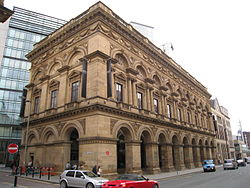
The Free Trade Hall on Peter Street, Manchester, England, was constructed in 1853–1856 on St Peter's Fields, the site of the Peterloo Massacre. It is now a Radisson hotel.
The hall was built to commemorate the repeal of the Corn Laws in 1846. The architect was Edward Walters. It was owned by the Manchester Corporation and was bombed in the Manchester Blitz; its interior was rebuilt and it was Manchester's premier concert venue until the construction of the Bridgewater Hall in 1996. The hall was designated a Grade II* listed building in 1963.

74 m
Great Northern Tower
The Great Northern Tower is a 72-metre (236 ft) sloped high-rise apartment building located on Watson Street in Manchester city centre, England. It is adjacent to its namesake, the Grade II listed Great Northern Warehouse. The building was proposed in 2001 and construction began in 2004 with completion in 2007. The total cost of the development was £32,800,000 and comprises 257 apartments. It was designed by Assael Architecture and built by Carillion.
The sloped style of the building was designed to complement the curved roof of the neighbouring Manchester Central Convention Complex, and create a distinctive silhouette to the Manchester skyline. Clad in glass, metal, and grey tiles, the tower slopes in profile from 10 to 25 storeys, and has two levels in the basement.