

 English
 Français
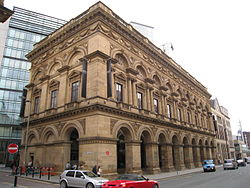
Free Trade Hall
The Free Trade Hall on Peter Street, Manchester, England, was constructed in 1853–1856 on St Peter's Fields, the site of the Peterloo Massacre. It is now a Radisson hotel. The hall was built to commemorate the repeal of the Corn Laws in 1846. The architect was Edward Walters. It was owned by the Manchester Corporation and was bombed in the Manchester Blitz; its interior was rebuilt and it was Manchester's premier concert venue until the construction of the Bridgewater Hall in 1996. The hall was designated a Grade II* listed building in 1963.
Lieux à Proximité Voir Menu

49 m
Theatre Royal, Manchester
The Theatre Royal in Manchester, England, opened in 1845. Situated next to the Free Trade Hall, it is the oldest surviving theatre in Manchester. It was commissioned by Mancunian businessman John Knowles who wanted a theatre venue in the city, and it is the oldest theatre building in Manchester city centre.
The Theatre Royal operated as a theatre from 1845 until 1921, when it closed in the face of growing competition from the Palace Theatre and Opera House. The building has since been converted numerous times for use as a cinema, bingo hall and nightclub. It has been unoccupied since 2011, with the nightclub hosting its last night on 31 December 2010.
In 2012, the building was purchased by Edwardian Hotels, owner of the neighbouring Radisson Edwardian. Edwardian Hotels have no intention of re-developing the Grade II listed building and it was placed on the Theatres Trust's "At Risk" register in 2013. Recent infractions include an order in 2019 for making alterations without listed consent and in 2024 for leaks into the interior.

55 m
Great Northern Tower
The Great Northern Tower is a 72-metre (236 ft) sloped high-rise apartment building located on Watson Street in Manchester city centre, England. It is adjacent to its namesake, the Grade II listed Great Northern Warehouse. The building was proposed in 2001 and construction began in 2004 with completion in 2007. The total cost of the development was £32,800,000 and comprises 257 apartments. It was designed by Assael Architecture and built by Carillion.
The sloped style of the building was designed to complement the curved roof of the neighbouring Manchester Central Convention Complex, and create a distinctive silhouette to the Manchester skyline. Clad in glass, metal, and grey tiles, the tower slopes in profile from 10 to 25 storeys, and has two levels in the basement.

59 m
Intercontinental Tower, Manchester
The Intercontinental Tower, Manchester is a cancelled landmark skyscraper that was proposed in Manchester city centre, England. The building would have been a five-star luxury hotel run by InterContinental Hotels Group, and developed by Northern Irish development firm, Benmore.
The skyscraper was proposed in a press release by developer Benmore in May 2009 and discussed with Manchester City Council in summer 2009. In 2010, the tower was part of the city council's preliminary plans to regenerate the surrounding civic quarter, and opposition to building a skyscraper in the heart of its historic district had been minimal.
The tower would have featured a helipad and two decorative spires, much like the Willis Tower in Chicago, which would have taken its pinnacle height to approximately 200 m (660 ft), 30 m taller than Greater Manchester's tallest skyscraper at the time, the Beetham Tower. The plans for the 48-storey tower were drawn up before the Great Recession but were abandoned when the financial market crashed. Planning negotiations resumed and architect Roger Stephenson designed a 25-storey tower to contain 270 hotel rooms and a presidential suite at the top. The theatre façade was to be retained to become the entrance to the hotel foyer. The structure was intended to be created behind the theatre's façade.

71 m
Albert Hall, Manchester
The Albert Hall is a music venue in Manchester, England.
Built as a Methodist central hall in 1908 by the architect William James Morley of Bradford and built by J. Gerrard & Sons Ltd of Swinton, it has been designated by English Heritage as a Grade II listed building. The main floor was used as a nightclub from 1999 to 2011. The second floor, the Chapel Hall, unused since 1969, was renovated in 2012–14 for music concerts.
The venue hosted a few events towards the end of 2013. It officially reopened on 6 February 2014, with a performance by Anna Calvi.