

 English
 Français

Zawiya of Sidi Abd el-Aziz
The Zawiya of Sidi Abd el-Aziz (alternate spellings include Zaouia of Sidi Abdelaziz) is an Islamic religious complex (zawiya) in Marrakesh, Morocco. It is centered around the tomb of the Muslim scholar and Sufi saint Sidi Abu Faris Abd al-Aziz Abd al-Haq at-Tabba', who died in Marrakesh in 1508. Sidi Abd el-Aziz is considered one of the Seven Saints of Marrakesh, and his tomb was a prominent stop for pilgrims to Marrakesh. The zawiya is located on Rue Mouassine (Mouassine Street) at its intersection with Rue Amesfah.
1. Historical background
Sidi Abd al-Aziz at-Tabbaa' was the most important disciple of the Sufi master al-Jazuli, who died in 1465 and whose mausoleum is also found in Marrakesh (after his body was moved there by the Saadians in 1523-24). At-Tabba', a native of Marrakesh, gained his reputation while teaching at the al-'Attarine Madrasa in Fes and came to be seen as al-Jazuli's spiritual successor. Along with al-Jazuli and five others, he also came to be considered one of the Seven Saints of Marrakesh (a religious institution officially established by Sultan Moulay Ismai'l), and was considered the patron saint of the city's tanners in particular. Among these Seven Saints was also Sidi Abdallah al-Ghaswani who himself was a disciple and successor of Sidi Abdelaziz and was later buried in another zawiya further south.
The zawiya complex presents a mix of Saadian and later Alaouite architecture. The mausoleum first took shape under the Saadians in the early 16th century. According to historian Gaston Deverdun, the current building dates largely from the time of Moulay Muhammad ibn Abdallah (governor of Marrakesh after 1746 and sultan from 1757-1790), who is responsible for building and restoring many monuments in the city.
1. See also
Zawiya of Muhammad Ben Sliman al-Jazuli Zawiya of Sidi Bel Abbes
1. References


1. External links
Zawiya Sidi Abdel Aziz Tebba at Archnet (includes pictures of the mosque's interior)
Nearby Places View Menu

Walls of Marrakesh

Ben Youssef Mosque
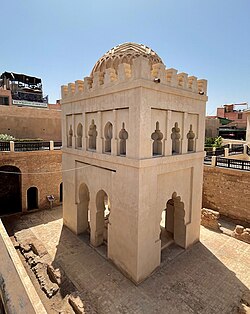
Almoravid Qubba
