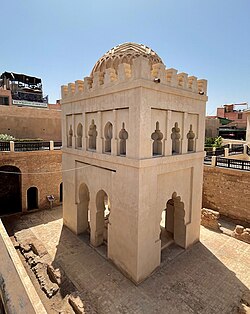
The Zawiya of Sidi Abd el-Aziz (alternate spellings include Zaouia of Sidi Abdelaziz) is an Islamic religious complex (zawiya) in Marrakesh, Morocco. It is centered around the tomb of the Muslim scholar and Sufi saint Sidi Abu Faris Abd al-Aziz Abd al-Haq at-Tabba', who died in Marrakesh in 1508. Sidi Abd el-Aziz is considered one of the Seven Saints of Marrakesh, and his tomb was a prominent stop for pilgrims to Marrakesh. The zawiya is located on Rue Mouassine (Mouassine Street) at its intersection with Rue Amesfah.

1. Historical background

Sidi Abd al-Aziz at-Tabbaa' was the most important disciple of the Sufi master al-Jazuli, who died in 1465 and whose mausoleum is also found in Marrakesh (after his body was moved there by the Saadians in 1523-24). At-Tabba', a native of Marrakesh, gained his reputation while teaching at the al-'Attarine Madrasa in Fes and came to be seen as al-Jazuli's spiritual successor. Along with al-Jazuli and five others, he also came to be considered one of the Seven Saints of Marrakesh (a religious institution officially established by Sultan Moulay Ismai'l), and was considered the patron saint of the city's tanners in particular. Among these Seven Saints was also Sidi Abdallah al-Ghaswani who himself was a disciple and successor of Sidi Abdelaziz and was later buried in another zawiya further south.

The zawiya complex presents a mix of Saadian and later Alaouite architecture. The mausoleum first took shape under the Saadians in the early 16th century. According to historian Gaston Deverdun, the current building dates largely from the time of Moulay Muhammad ibn Abdallah (governor of Marrakesh after 1746 and sultan from 1757-1790), who is responsible for building and restoring many monuments in the city.

1. See also

Zawiya of Muhammad Ben Sliman al-Jazuli Zawiya of Sidi Bel Abbes

1. References


1. External links

Zawiya Sidi Abdel Aziz Tebba at Archnet (includes pictures of the mosque's interior)

Lieux à Proximité Voir Menu
Location Image
3 m

Zaouïa de Sidi Abdelaziz

La Zaouia de Sidi Abdelaziz est un complexe religieux islamique (zaouïa) situé à Marrakech, au Maroc. Il est centré autour de la tombe du savant musulman et saint soufi Sidi Abu Fāris ‘Abd al-‘Azīz ‘Abd al-Haq at-Tabbā', décédé à Marrakech en 1508. Sidi Abdelaziz est considéré comme l'un des sept saints de Marrakech, et sa tombe est une étape importante pour les pèlerins à Marrakech. La zaouïa est située au cœur de la médina de Marrakech dans le quartier Mouassine.
Location Image
130 m

Marrakech-Médina

Marrakech-Médina est un des cinq arrondissements de la ville de Marrakech, elle-même située au sein de la préfecture de Marrakech, dans la région de Marrakech-Safi. Cet arrondissement a connu, de 1994 à 2004 (années des derniers recensements), une baisse de population, passant de 192 323 à 167 233 habitants. Depuis les élections communales de 2021, le Président de cet arrondissement est Mohamed Belaroussi (محمد بنلعروسي).
Location Image
180 m

Mosquée Ben Youssef (Marrakech)

La mosquée Ben Youssef (parfois orthographiée « mosquée Ibn Yusuf ») est une mosquée de la Médina de Marrakech, au Maroc, du nom de l'émir almoravide Ali ben Youssef. Elle compte parmi les mosquées les plus anciennes de Marrakech.
Location Image
187 m

Qoubba almoravide

La qoubba almoravide (arabe : قبة المرابطية) ou qoubba al-Baadiyn (قبة البعديين) ou qoubba al-Barudiyyin (قبة الباروديين) est un édifice religieux de Marrakech érigé en 1117 par Ali ben Youssef. Il constitue le dernier vestige de la dynastie des Almoravides au Maroc. La qoubba (« coupole ») était le centre d'ablution pour les croyants se rendant à la mosquée. Le complexe, en activité pendant plusieurs siècles, était en outre l'une des premières fontaines de la ville de Marrakech et assurait donc l'approvisionnement en eau de la population et de ses animaux.
Location Image
209 m

Fontaine chrob ou chouf

La fontaine chrob ou chouf située près de la mosquée Ben Youssef au cœur de la médina de Marrakech, a été élevée sous Ahmed el-Mansour (1578-1603). Son couronnement est exécuté en bois sous forme de nid d’abeille, le tout couvert d’un toit en pente revêtu de tuiles vertes. L’inscription gravée sur le linteau est une calligraphie andalouse très semblable à celle de la fontaine Mouassine. Une des inscriptions ciselées invite le passant à « boire et regarder » (en arabe "echroub ou chouf"). Cette fontaine saadienne est classée depuis 1985 patrimoine mondial par l'UNESCO. Portail de Marrakech Portail des bassins et des fontaines