Location Image

All Saints Church, Speke

All Saints Church is in Speke, Liverpool, Merseyside, England, standing at the junction of Hale Road and Speke Church Road. It is an active Anglican parish church in the deanery of Liverpool South Childwall, the archdeaconry of Liverpool, and the diocese of Liverpool. Its benefice is united with that of St Aidan, Speke. The church is recorded in the National Heritage List for England as a designated Grade II listed building.

1. History

The church was built between 1872 and 1875, and designed by John Loughborough Pearson. It was consecrated by the Bishop of Chester on 21 June 1876. The church was enlarged in the 1930s; this included a new vestry, offices, and the installation of electric lighting.

1. Architecture


1. = Exterior =

All Saints is constructed in snecked red stone, with a tiled roof. Its architectural style includes Decorated details, including Geometric tracery in some of the windows. Its plan consists of a nave, a north aisle, a north transept, a chancel with a north vestry, and a southwest steeple. On the northwest side of the tower is a stair turret, and the entrance to the church is on the south side of the tower. Above the entrance are three lancet windows, and above them, the bell openings have two lights. The tower is surmounted by a broach spire with lucarnes. At the west end of the church, the nave has a four-light window, and the aisle window has two lights. The windows along the side of the nave have three lights, and those along the aisle have two lights. The east window has five lights; this window is flanked by gabled buttresses. In the transept is a three-light window.

1. = Interior =

Inside the church is a four-bay arcade carried on round columns. The chancel arch is carried on corbelled responds (half-columns). Between the chancel and the organ loft is a pair of arches with a tympanum containing a quatrefoil. The stained glass in the windows was made by Clayton and Bell. The original pipe organ had two manuals, and was made by Gray and Davidson. It was replaced in the 1930s. There is a ring of three bells, which were cast in 1874 by John Taylor & Co, but these are no longer ringable.

1. Appraisal

The church was designated as a listed building on 14 March 1975. It is listed at Grade II, which is the lowest of the three grades, and includes buildings that are "of special interest, warranting every effort to preserve them.". The church is discussed by Pollard and Pevsner in the Buildings of England series. They are of the opinion that it is "not on a par" with Pearson's Church of St. Agnes elsewhere in Liverpool, and state that it is "simple, reasonable and serious, but devoid of Pearson's great enthusiasm".

1. See also

Grade II listed buildings in Liverpool-L24 List of new ecclesiastical buildings by J. L. Pearson

1. References


1. External links

Correspondence about the building of the church from the archives of the Speke Hall Estate

Nearby Places View Menu
Location Image
700 m

Yellow Submarine (sculpture)

The Yellow Submarine in Liverpool is a large model representation of the submarine featured in the 1968 animated film Yellow Submarine, inspired by the 1966 song of the same name on The Beatles' album Revolver. It was built by a group of about 80 apprentices from Cammell Laird's shipyard, designed in part by Mr L Pinch, a draughtsman at the yard, for exhibition at the International Garden Festival in Liverpool in 1984. The Submarine was in a garden themed around the Beatles, one of 60 such themed gardens, and was highly popular. The garden took the form of an apple-shaped labyrinth, containing symbolic references to the group, and included a bronze statue of John Lennon, which now stands at Liverpool John Lennon Airport. The Submarine itself is some 51 feet long (15.62 m) and 15 feet (4.57 m) high, and weighed 18 tons. Built of steel, it has a replica control cabin containing genuine submarine equipment, and twin spiral staircases leading to the bridge, which gave a panoramic view of the garden. These were accessible via doorways at the side. Painted in vivid yellow, the hull was tilted as if about to submerge. After the Festival site closed, the Submarine was sited for several years in Chavasse Park, an open space in the city centre, where it was readily visible to traffic entering the city centre from the south. It was retired from public view when its condition deteriorated, but was renovated to find a new home at Liverpool John Lennon Airport in 2005. Airport boss Neil Pakey stated: "Other airports have the Concorde, we have the Yellow Submarine."
800 m

Liverpool 08 Collection

The Liverpool 08 Collection was the public art collection exhibited by Liverpool John Lennon Airport in conjunction with the Liverpool Culture Company for the duration of 2008, the year when Liverpool was the European Capital of Culture. Exhibits were launched before and during the year by various celebrities including Yoko Ono and Phil Redmond and much of the exhibition remains in place today. As well as the iconic sculptures, The Yellow Submarine sculpture and the John Lennon Statue, the different pieces of artwork situated around the public areas of the terminal included; two rare suits worn by John Lennon, photographs by Harry Goodwin and Paul Saltzman, mosaics from Debbie Ryan, graphic designs by John McFaul, a film by Nick Jordan, a performance of Brian Eno's 'Music for Airports' and artwork from 50 schoolchildren at St Ambrose Primary School in Speke
Location Image
849 m

ROC Post Speke

ROC Post Speke is a nuclear monitoring post in Speke, Liverpool built during the Cold War. It was operational between 1959 and 1968. It has the distinction of being the only post of its type in Merseyside. As of 2012, plans to renovate the post were put under consideration as part of the RAF Speke museum project, with funds donated to Help for Heroes.
Location Image
1.1 km

1965 Liverpool Vickers Viscount crash

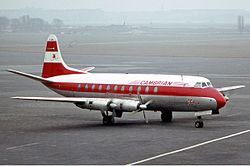
On 20 July 1965 a Vickers Viscount of Cambrian Airways crashed into Thompson & Capper's mothball factory on approach to Liverpool International Airport, after a flight from Ronaldsway Airport, Isle of Man. Both crew (Michael Warrington and Peter Kenny) were killed, as well as the only two persons in the factory (June Simpson and Elizabeth Farrell) who were working late.