

 English
 Français

Simonburn
Simonburn is a small human settlement in Northumberland, England.
Nearby Places View Menu
794 m
Nunwick Hall
Nunwick Hall is a privately owned 18th-century country house near Simonburn, Northumberland in North East England. The estate has been the home of the Allgood family since the 17th century. The house is a Grade II* listed building but is not open to the public.
In 1738 Lancelot Allgood married his cousin Jane Allgood, who was heiress to the Nunwick estate, and they built the present three-storey five-bayed house to a Georgian style design by architect Daniel Garrett.
Improvements made in 1829 by architect Ignatius Bonomi included a new entrance porch and east wing.
The grounds were laid out in 1760 and are protected as a Registered Historic Park and as a Grade II listed building.
The ruinous Simonburn Castle to the west was partly rebuilt as a Gothic eye-catcher or folly in 1766, to be seen from Nunwick Hall, but has since collapsed.

1.9 km
Limestone Corner
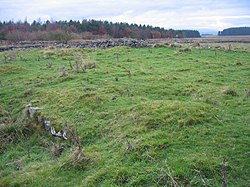
Limestone Corner is an area of Hadrian's Wall (and associated defences) at its most northerly point, in present-day northern England. It represents the most northerly point of the Roman Empire, outside the two periods during which the Antonine Wall was occupied by the Roman military. Other notable features at Limestone Corner are the wall ditch at this point, which was never completely excavated, a Roman camp and the site of Milecastle 30. Also present is a trig point. The B6318 Military Road also runs through Limestone Corner, as does the Military Way, serving Milecastle 30. The Military Way is visible on the ground at this point, the most eastern point where this is the case.
The name "Limestone Corner" is accepted through extensive usage. It has no geographical status or appear on any official maps; the hill on which it stands is known as Teppermoor Hill.
1.9 km
Milecastle 30
Milecastle 30 (Limestone Corner) was a milecastle of the Roman Hadrian's Wall. Its remains exist as an outward-facing scarp with a maximum height of 0.8 metres (2.6 ft). Masonry from the east wall (both faces) remains in situ. The remaining stretch is 3.1 metres (10 ft) in length by 2.25 metres (7.4 ft) thick, and survives to a height of 0.6 metres (2.0 ft). It is located at the western part of Limestone Corner, just off the B6318 Military Road.

2.0 km
Military Road (Northumberland)
The Military Road is part of the B6318 road in Northumberland, England, which runs from Heddon-on-the-Wall in the east to Greenhead in the west.
For much of its length, the Military Road is straight and resembles a Roman road. However, the term "military road" comes from the impetus to build a road suitable for the movement of military equipment and vehicles between Newcastle and Carlisle. This was largely in response to the poor conditions encountered on the road by Hanoverian forces under Field Marshal Wade in 1746 when trying to suppress the Jacobites fighting for Bonnie Prince Charlie in the North. The struggle of the troops under Field Marshal Wade, and his association with other 'Military Roads' in Scotland, is likely to be the source of the claim that he was also responsible for this route.
The road runs alongside Hadrian's Wall for much of its length, and long stretches of it are built on the foundations of the wall.