

 English
 Français
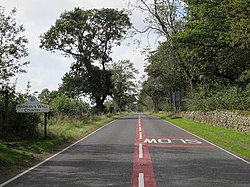
Milecastle 19
Milecastle 19 (Matfen Piers) was a milecastle of the Roman Hadrian's Wall. Sited just to the east of the hamlet of Matfen Piers, the milecastle is today covered by the B6318 Military Road. The milecastle is notable for the discovery of an altar by Eric Birley in the 1930s. An inscription on the altar is one of the few dedications to a mother goddess found in Roman Britain, and was made by members of the First Cohort of Varduli from northern Spain. The presence of the Vardulians at this milecastle has led to debate amongst archaeologists over the origins of troops used to garrison the wall. A smaller altar was found at one of the two associated turrets.
Nearby Places View Menu

1.5 km
Milecastle 20
Milecastle 20 (Halton Shields) was one of the milecastles on Hadrian's Wall (grid reference NZ01886868). It is situated in the hamlet of Halton Shields, and was excavated in 1935. There is no visible trace of the milecastle above ground.
1.5 km
Milecastle 18
Milecastle 18 (East Wallhouses) was a milecastle of the Roman Hadrian's Wall. It is located to the west of the settlement of East Wallhouses in Northumberland and is visible as a platform in the ground. The milecastle is of a unique construction, having a gateway associated with builders of the Legio II Augusta and a layout typical of the Legio VI Victrix or Legio XX Valeria Victrix. Historians have suggested that it may have been begun by men of one legion and finished by those of another. One of Milecastle 18's associated turrets shows evidence of being used as a workshop, possibly for the repair of shoes.
3.0 km
Milecastle 17
Milecastle 17 (Welton/Whittledean) was a milecastle of the Roman Hadrian's Wall. The milecastle is located near to the Whittle Dene reservoirs and is visible as a platform in the ground. Just 174m west of the milecastle is a distinct change in wall construction, indicating that it may have formed a boundary between different legions. The existence of the milecastle has been known since at least 1732 and excavations have produced numerous finds and evidence of post-Roman occupation. The associated turrets both lie beneath the B3618 Military Road. A stone found near the milecastle is the only known written record of the name of Gaius Julius Marcus, a Roman Governor of Britain whose name has been erased from other inscriptions possibly because he fell out of favour with Emperor Caracalla.

3.1 km
Matfen Hall
Matfen Hall is a 19th-century country mansion in Matfen, Northumberland, England, the seat of the Blackett baronets and now also a hotel and country golf club. It is a Grade II* listed building.
The manor of West Matfen was owned in the 13th century by Philip de Ulcote and passed through his sisters to Felton, by marriage to Hastings and later to Lawson. In 1625 the estate was bought by Lancelot Fenwick of a branch of the old-established local family. The manor and manor house, West Matfen High Hall, was sold in 1680 to John Douglas, Town Clerk of Newcastle. His granddaughter and Douglas heiress married Sir Edward Blackett, Bt., in 1757, thereby bringing the estate into the Blackett family.
The present house was built to replace the old manor, in 1832 for Sir William Blackett, 6th Baronet. The impressive Jacobean-style mansion has a three-storey seven-bay entrance front. An important internal feature is a full-height Gothic hall.
Between 1965 and 1994 the house was leased out, operating as the Northumberland Cheshire Home.
Sir Hugh Blackett, the 12th Baronet, and Lady Blackett have since converted the hall into a hotel and country club, which opened in 1999. The Blacketts now live at Halton Castle, a few miles west of Matfen.