

 English
 Français

Black Heddon
Black Heddon is a village and former civil parish, now in the parish of Belsay, in the county of Northumberland, England. It is situated to the north-west of Newcastle upon Tyne, between Stamfordham and Belsay. In 1951 the parish had a population of 45. According to local legend, the village was once haunted by a ghost named Silky, who used to jump onto travellers' horses. In nearby Belsay is a tree overlooking a waterfall which is known as Silky's Chair.
Nearby Places View Menu
2.2 km
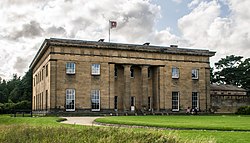
Belsay Hall
Belsay Hall is a Regency style country house located at Belsay, Northumberland. It is regarded as the first British country house to be built entirely in the new Greek Revival style. It is a Grade I listed building. It was built to supersede Belsay Castle and its adjoining earlier hall just a few hundred yards away, and is part of the same estate.

2.3 km
Belsay Castle
Belsay Castle is a 14th-century medieval castle situated at Belsay, Northumberland, England. It is a Scheduled Monument and a Grade I listed building.
The main structure, a substantial three-storey rectangular pele tower with rounded turrets and battlements, was constructed about 1370, and was the home of the Middleton family. In 1614 Thomas Middleton built a new manor house attached to the tower. A west wing was added in 1711 but was largely demolished in 1872 by Sir Arthur Middleton when the remainder of the house was considerably altered.
The castle was abandoned as a residence by the family in the early 19th century when Sir Charles Monck built Belsay Hall close by. The interiors were largely removed and it was then used as a ready-made folly, as was fashionable among the aristocracy at the time, serving as the setting for garden parties and other entertainments.
The castle is administered by English Heritage and is open to the public.
3.4 km
Belsay
Belsay is a village and civil parish in Northumberland, England. The village is about 5 miles (10 km) from Ponteland on the A696, which links the village with Newcastle upon Tyne and Jedburgh. The population of the civil parish was 436 at the 2001 census, increasing to 518 at the 2011 Census.
Scottish nobleman and doctor, John de Strivelyn, was granted the manor around 1340 by Edward III. On his death, the estate passed to his daughter Christiana, who was married to Sir John Middleton, and it has remained with the Middleton family ever since.
Belsay was formerly a township in the parish of Bolam, in 1866 Belsay became a civil parish. Belsay parish includes the former parishes of Bitchfield, Black Heddon, Bolam, Bolam Vicarage, Bradford, Gallowhill, Harnham, Newham, Shortflatt, Trewick, and Wallridge which were merged with Belsay on 1 April 1955.
Belsay is home to Belsay Castle, a fine medieval castle, and to Belsay Hall.
4.0 km
Fenwick Tower, Northumberland
Fenwick Tower was a 12th-century tower house at Fenwick, Matfen, Northumberland, England.
The house was the home of the Fenwick family from the 12th century until they moved to Wallington in the 16th century.
In 1378 John Fenwick was granted a licence to crenelate the house. The tower was largely demolished in about 1775 at which time a hoard of medieval gold coins was discovered.
The sparse remains of the tower are now incorporated into a 17th-century farmhouse and are protected by Grade II listed building status
On 15 February 2010 human remains were found buried next to a cottage in the hamlet of Fenwick Towers. Radio-carbon dating of the remains indicated they likely dated to the 13th or 14th centuries.