

 English
 Français
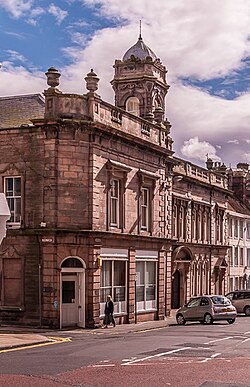
Corn Exchange, Berwick-upon-Tweed
The Corn Exchange is a commercial building in Sandgate, Berwick-upon-Tweed, Northumberland, England. The structure, which is now used as an apartment block, is a Grade II listed building.
Nearby Places View Menu
133 m
Berwick-upon-Tweed Power Station
Berwick Power Station was a small coal-fired power station situated at the mouth of the River Tweed, at Berwick-upon-Tweed in Northumberland, North East England. It operated from 1903 until the early 1940s.

180 m
Dewars Lane
Dewar's Lane is an alley of medieval origin in the centre of Berwick-upon-Tweed. Over the centuries, heavy cart-wheels have cut deep grooves in its setts.
Once painted by the artist L. S. Lowry, it fell into an extreme state of dilapidation, overrun with pigeons and seagulls. Berwick Preservation Trust then stepped in and created a plan for the renovation of the lane's major building, Dewar's Lane Granary.
The Granary (which is situated on Dewar's Lane) has recently been strapped (as it has a tilt greater than the Leaning Tower Of Pisa) and transformed into a Youth Hostel, Bistro, Major Art Gallery and Public Meeting Rooms. The restored building is not only accessible from street level but also has access from both Berwick's Elizabethan Walls and Historic Quayside. This £5ml renovation will now remove what was considered to be the largest eyesore in the town.

189 m
Berwick-upon-Tweed
Berwick-upon-Tweed ( BEH-rik), sometimes known as Berwick-on-Tweed or simply Berwick, is a town and civil parish in Northumberland, England, 2.5 mi (4 km) south of the Anglo-Scottish border, and the northernmost town in England. The 2011 United Kingdom census recorded Berwick's population as 12,043.
The town is at the mouth of the River Tweed on the east coast, 56 mi (90 km) south east of Edinburgh, 65 mi (105 km) north of Newcastle upon Tyne, and 345 mi (555 km) north of London. Uniquely for England, the town is slightly further north than Denmark's capital Copenhagen and the southern tip of Sweden, further east of the North Sea, which Berwick borders.
Berwick was founded as an Anglo-Saxon settlement in the Kingdom of Northumbria, which was annexed by England in the 10th century. A civil parish and town council were formed in 2008 comprising the communities of Berwick, Spittal and Tweedmouth. It is the northernmost civil parish in England.
For more than 400 years, the area was central to historic border wars between the Kingdoms of England and Scotland, and several times possession of Berwick changed hands between the two kingdoms. The last time it changed hands was when Richard, Duke of Gloucester (later King Richard III) retook it for England in 1482. To this day, many Berwickers feel a close affinity to Scotland. Both Berwick Rangers Football Club and Berwick Rugby Football Club play in Scottish leagues.
Berwick remains a traditional market town and also has some notable architectural features, in particular its medieval town walls, its Georgian Town Hall, its Elizabethan ramparts, and Britain's earliest barracks buildings, which Nicholas Hawksmoor built (1717–1721) for the Board of Ordnance.

211 m
Berwick Town Hall
Berwick Town Hall is a municipal facility in Marygate, Berwick-upon-Tweed, England. The town hall, which was the headquarters of Berwick-upon-Tweed Borough Council, is a Grade I listed building.