

 English
 Français

Entwistle railway station
Entwistle railway station (first opened in 1848) is 5+3⁄4 miles (9.3 km) north of Bolton and serves the village of Entwistle. It is also the closest station to Edgworth. Owing to the remote location and low passenger numbers, Entwistle was a request stop for several years. After 21 May 2023, it was no longer a request stop. It is served by Northern services on the Ribble Valley line towards Blackburn and Clitheroe in England.
Nearby Places View Menu

258 m
Entwistle, Lancashire
Entwistle is a village in the civil parish of North Turton, in the Blackburn with Darwen unitary authority area in the ceremonial county of Lancashire, England.
Its name derives from the Old English ened and twisla which means a river fork frequented by ducks. The name was recorded as Hennetwisel in 1212, Ennetwysel in 1276 and Entwissell in 1311. Entwistle is situated in a fork between the Edgeworth Brook and a smaller tributary. Entwistle was originally a township in the chapelry of Turton which was part of the large ecclesiastical parish of Bolton le Moors in the hundred of Salford. In 1866 Entwistle became a separate civil parish, on 30 September 1898 the parish was abolished and merged with Edgworth. In 1891 the parish had a population of 287.
Entwistle Hall is a 16th-century farmhouse which dates from the time of the Entwistle family. It is a Grade II listed building. The south facing front of the Hall still has many Tudor features including mullioned windows with dripstone headings.
Entwistle railway station, situated between Darwen and Bromley Cross railway stations on the line between Blackburn and Bolton, was a request stop until the May 2023 timetable change. The station is situated close to the Strawbury Duck public house.
Nearby streams have been dammed to form the Wayoh and Turton and Entwistle Reservoirs. The area is popular with walkers, anglers and joggers.
Entwistle, which lies to the north-eastern corner of the old Turton Urban District (which also includes Edgworth, Quarlton, Bradshaw, Harwood, Turton, and Longworth), is about 1,000 feet above sea level and consists of some 1,668 acres.

700 m
Turton and Entwistle Reservoir
Turton and Entwistle Reservoir is a water reservoir in the village of Edgworth, Lancashire, England. The reservoir's existence is due to the Entwistle Dam. When constructed in 1832 the Entwistle Dam was the highest in Britain; it rises 108 feet from the base. The reservoir contains almost 750 thousand imperial gallons (roughly 3,400,000 litres) and, with the Wayoh Reservoir just below, satisfies around 50% of Bolton's need for drinking water.
Entwistle Dam was designed by Thomas Ashworth, a local land surveyor, overseen by Jesse Hartley, the Liverpool Docks engineer. Other works were by Joseph Jackson, an engineer and surveyor from Bolton. It was built for the Commissioners of the Turton and Entwistle Reservoir, a group of local mill owners who obtained an enabling act of Parliament, the Turton and Entwistle Reservoir Act 1832 (2 & 3 Will. 4. c. xxiv) to regulate the supply of water in Bradshaw Brook for water power for the finishing textiles.
Records suggest it was built entirely of puddle clay with no distinct core. Earth dams usually have a waterproof cutoff under their earthworks designed to stop seepage under the dam but it is doubtful whether there was any such a cutoff at Entwistle. The reservoir has a rock-cut outlet tunnel driven through the valley side rather than a culvert or pipeline and a siphon draw-off pipe. The dam is 108 ft high and 110 metres long at the crest. The present overflow channel and valve tower were added by the Bolton Corporation Water Works who took over the reservoir in 1864.
1.2 km
Wayoh Reservoir
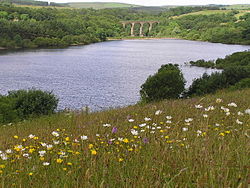
Wayoh Reservoir is a water reservoir in the town of Edgworth, Lancashire, England. It was completed on 28 April 1876 to supply water to Bolton. Wayoh, together with the Turton and Entwistle Reservoir, make up 50% of Bolton's drinking water.
In 1962 in response to an increasing demand for drinking water in Bolton, a treatment plant was built and the reservoir enlarged to its present capacity of 501 million imperial gallons (2.28 Gl). Today the treatment plant can supply almost 10 million imperial gallons (45 Ml) of drinking water per day.
The reservoir is crossed by the earlier built Armsgrove Viaduct; which was built between 1847 and 1848 by the Blackburn, Darwen and Bolton Railway to bridge Bradshaw Brook.
1.3 km
West Pennine Moors
The West Pennine Moors is an area of the Pennines covering approximately 90 square miles (230 km2) of moorland and reservoirs in Lancashire and Greater Manchester, England. It is a Site of Special Scientific Interest.
The West Pennine Moors are separated from the main Pennine range by the Irwell Valley to the east. The moorland includes Withnell, Anglezarke and Rivington Moors in the extreme west, Darwen and Turton Moors, Oswaldtwistle Moors and Holcombe Moors. These moors are lower in height than the main spine of the South Pennines. At 1,496 feet (456 m), the highest point is at Winter Hill. The area is of historical importance with archaeological evidence of human activity from Neolithic times. The area is close to urban areas, the dramatic backdrop to Bolton, Blackburn and Bury and neighbouring towns affording panoramic views across the Lancashire Plain and the Greater Manchester conurbation. The moorland is surrounded by the towns of Bolton, Chorley, Darwen, Horwich, Ramsbottom, Haslingden and Oswaldtwistle. Notable structures include Rivington Pike Tower, Winter Hill transmitting station, Peel Monument near Holcombe and the Jubilee Tower on Darwen Moor.
United Utilities owns around 40% of the land for water catchment. The company operates four information centres at Rivington, Jumbles Country Park, Roddlesworth and Haslingden Grane.