

 English
 Français

The Argentine Automobile Club building its national headquarters of ACA located in Palermo neighborhood in Buenos Aires. The building is designed in the Rationalist style by local architect Antonio U. Vilar and collaborators Alejandro Bustillo, was completed in 1942. on Buenos Aires' Avenida del Libertador. The building and its automobile museum are Palermo neighborhood landmarks.
Nearby Places View Menu
47 m
Argentine Automobile Club
The Argentine Automobile Club (Spanish: Automóvil Club Argentino, ACA) is Argentina's largest automobile association.
It was founded on June 11, 1904, by Dalmiro Varela Castex, who in 1892 had imported the country's first registered automobile, a Daimler, and in 1894 its second (a De Dion-Bouton). The ACA oversaw the first recorded Argentine auto racing event, in 1906, and became a member of the International Automotive Federation in 1926. It began to develop of national network of service stations following a 1936 agreement with the state oil concern, YPF. Offering its membership cartographic, roadside assistance, insurance and other services, the ACA was inducted into the International Tourism Alliance in 1952.
Its national headquarters, designed in the Rationalist style by local architect Antonio U. Vilar and collaborators Alejandro Bustillo, was completed in 1942 on Buenos Aires' Avenida del Libertador. The building and its automobile museum are Palermo neighborhood landmarks.
In 1954, the club sponsored the Mil Kilometros de la Ciudad de Buenos Aires, inviting cars from the Sports Car Club of America, including one driven by Carroll Shelby.
Rally Argentina

101 m
National Museum of Decorative Arts, Buenos Aires
The National Museum of Decorative Arts is an art museum in Recoleta, Buenos Aires, Argentina.
187 m
Avenida del Libertador (Buenos Aires)
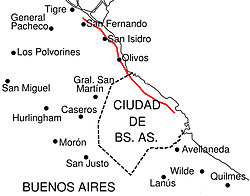
Avenida del Libertador is one of the principal thoroughfares in Buenos Aires, Argentina, and in points north, extending 25 km (16 mi) from the Retiro District of Buenos Aires (where it continues as Avenida Leandro N. Alem) to the northern suburb of San Fernando.

246 m
Unzué Palace
Unzué Palace (Spanish: El palacio Unzué), also known as Quinta Unzué, was the presidential residence of the Argentine Republic located in Buenos Aires during the presidency of Juan Domingo Perón (1946–1955), and became a place of pilgrimage and cult after the death of Eva Perón in 1952. The building's symbolic importance was such that, after the military coup that led to Perón's downfall in 1955, the dictators who subsequently took power ordered its complete demolition, to erase all traces of its former occupants.
The residence occupied a large plot of almost three blocks with tree-lined gardens. It was located between Avenida del Libertador, Austria, Agüero, and Avenida Las Heras. Following its destruction, the National Library of Argentina was constructed between 1962 and 1992.