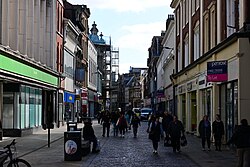
Whitefriargate is a pedestrianised street in the Old Town area of Kingston upon Hull, in the East Riding of Yorkshire, England. During the 20th century, it was one of the main shopping streets in the city centre, but some of the major stores have closed down, which has been attributed to out of town shopping centres. However, the Street still provides a useful link to and from the old town of Hull. Whitefriargate has 33 listed buildings according to Historic England, and was notable for the Beverley Gate at the west end of the street, which was the place of execution of Robert Constable in 1537. Over a hundred years later in 1642, the gate was closed to King Charles I by John Hotham on the order of Parliament, which provided a catalyst for the First English Civil War.

Nearby Places View Menu
Location Image
92 m

Hull Trinity House

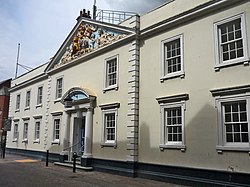
The Hull Trinity House, locally known as Trinity House, is a seafaring organisation consisting of a charity for seafarers, a school, and a guild of mariners. The guild originated as a religious guild providing support and almshouses for the needy, and established a school for mariners in 1787. By the 18th century it had responsibilities including management of the harbour at Hull, and buoys and pilotage in the Humber Estuary. After the loss of many of its responsibilities as a result of the River Humber Conservancy Act 1852 (15 & 16 Vict. c. cxxx), the guild continued its work as a charity, and the provision of education, which continues to the present day. The school, now known as Hull Trinity House Academy, is now a secondary boys' school. The charity, Hull Trinity House Charity, supports seafarers and their families; supported by property holdings, it operates rest homes, as well as Welton Waters Adventure Centre.
Location Image
113 m

Land of Green Ginger

The Land of Green Ginger (grid reference TA099287) is a narrow street at the bottom of Whitefriargate in the old town area of Kingston upon Hull, England. There are various commercial and residential buildings along the street. The Land of Green Ginger contains what may be the world's smallest window, being a slit which was used by the gatekeeper of the George Hotel to look out for stagecoaches and customers. The street was formerly known as Old Beverley Street. Various suggestions have been proposed for the derivation of its current name. It may simply refer to the sale or storage of the spice ginger in the Middle Ages. A record dating from 1853 indicates that a Mr Richardson "has made it most probable that the designation 'Land of Green Ginger' took place betwixt 1640 and 1735". The unknown writer then goes on to speculate that, as a Dutch family with the surname Lindegreen (meaning "green lime tree") was known to live in Hull during the earlier part of the 19th century, the modern name may be a corruption of Lindegroen jonger (Lindegreen junior). Another idea, dating from 1880, is that the name is a corruption of "Landgrave Granger", meaning a walk or pathway approaching the home of the Landgrave family. In 2017, Hull UK City of Culture commissioned a community engagement project, called Land of Green Ginger. It was presented in the form of a series of Acts of Wanton Wonder, united under an overarching narrative. The projects were developed and delivered with artists who worked both independently and in collaboration to bring new kinds of art and culture into the neighbourhoods outside the city centre. Act I was 7 Alleys, Act II was The Golden Nose of Green Ginger, Act III The Longhill Burn, Act IV Re-Rediffusions Voice Park, Act V Micropolis by Davy and Kristin McGuire and Act VI Land of Green Ginger Unleashed. In 2022, Hull Trains named one of their Class 802 Paragon trains 'Land of Green Ginger' after the street.
Location Image
136 m

Trinity Market

Trinity Market is a Grade II listed Edwardian building in the city of Kingston upon Hull, in the East Riding of Yorkshire, England. A market has existed on the site since at least 1469, and in 1904 a building was provided as an indoor market place.
Location Image
153 m

Princes Quay

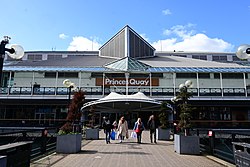
Princes Quay is a shopping centre in the heart of Kingston upon Hull, East Riding of Yorkshire, England. The centre is unusual in that it is built on stilts over Prince's Dock after which it is named. It was opened in 1991.