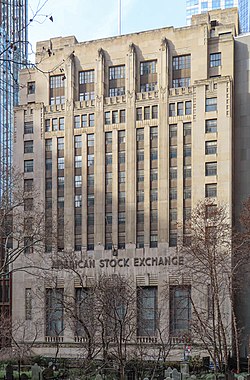
L'American Stock Exchange, souvent abrégé en AMEX, est une bourse ayant son siège à New York. L'AMEX constitue l'un des trois plus importants marchés boursiers américains, avec le New York Stock Exchange (la bourse de Wall Street) et le NASDAQ. L'American Stock Exchange est géré par l'American Stock Exchange LLC, une filiale de la National Association of Securities Dealers, qui exploite également le NASDAQ. L'AMEX est réputée pour avoir des règles souples, ce qui permet à des entreprises plus modestes d'y être cotées, notamment des sociétés étrangères, surtout canadiennes. Le volume des échanges représente 10 % de ceux effectués au NYSE. L'origine de l'AMEX remonte probablement à l'époque coloniale, quand les agents de change vendaient leurs titres de placement dans la rue, en bravant les intempéries, près de Broad Street et d'Exchange Place. Cette activité ancestrale, qui était fort bruyante, avait fini par générer un système gestuel pour communiquer efficacement dans le brouhaha. En 1921, le marché boursier a été transféré dans l'immeuble qui l'abrite encore aujourd'hui. Elle a été rachetée en 2008 par NYSE Euronext.

Lieux à Proximité Voir Menu
37 m

Trinity Court Building (1879–1926)

The Trinity Court Building was a building in Lower Manhattan, New York City.
Location Image
37 m

Trinity Court Building (1927–2015)

The Trinity Court Building was a building in Lower Manhattan, New York City.
Location Image
40 m

American Stock Exchange Building

The American Stock Exchange Building, formerly known as the New York Curb Exchange Building and also known as 86 Trinity Place or 123 Greenwich Street, is the former headquarters of the American Stock Exchange. Designed in two sections by Starrett & van Vleck, it is located between Greenwich Street and Trinity Place in the Financial District of Lower Manhattan in New York City, with its main entrance at Trinity Place. The building represents a link to the historical practices of stock trading outside the strictures of the New York Stock Exchange (NYSE), which took place outdoors "on the curb" prior to the construction of the structure. The building was originally erected in 1921, thus improving the stature of the New York Curb Exchange, which had been a curbside exchange. The structure was enlarged between 1929 and 1931 following an increase in trading volume. The New York Curb Exchange was renamed the American Stock Exchange, commonly known as the AMEX for short, in 1953. The AMEX moved out after merging with the NYSE in 2008. The structure was subsequently purchased by developers who planned to convert the building into a hotel. The original structure, facing Greenwich Street to the west, is designed in the Renaissance Revival style, with a set of large arched windows providing light to the former trading floor. The eastern expansion, on Trinity Place to the east, is designed in the Art Deco style as a 14-story building. The expanded structure contained offices and conference rooms, as well as an elaborately decorated facade with a central entrance and reliefs signifying the building's use. The American Stock Exchange Building was designated a National Historic Landmark in 1978 and was designated a city landmark by the New York City Landmarks Preservation Commission in 2012. It is also a contributing property to the Wall Street Historic District, a NRHP district created in 2007.
65 m

Trinity Church (Manhattan)

Trinity Church is a historic parish in the Episcopal Diocese of New York. The church is located at 89 Broadway opposite Wall Street, in the Financial District of Lower Manhattan in New York City. Known for its centuries of history, prominent location, distinguished architecture and bountiful endowment, Trinity's congregation is said to be "high church", its activities based on the traditions of the Episcopal Church and the worldwide Anglican Communion in missionary outreach, and fellowship. In addition to its main church, Trinity parish maintains two chapels: St. Paul's Chapel, also in Lower Manhattan, and the Chapel of St. Cornelius the Centurion on Governors Island. The Church of the Intercession, the Trinity Chapel Complex and many other of Manhattan's Episcopal congregations were once part of Trinity parish. Columbia University was founded on the church's grounds as King's College in 1754. The current church building is the third to be constructed for the parish, and was designed by Richard Upjohn in the Gothic Revival style. Trinity's first church was a single-story rectangular structure with tall steeple facing the Hudson River, which was constructed in 1698 and destroyed in the Great New York City Fire of 1776. After using St. Paul's Chapel, the parish's second church was built in the present location facing Wall Street and was consecrated in 1790. The third and current church was erected from 1839 to 1846 and was the tallest building in the United States until 1869, as well as the tallest in New York City until 1890. In 1876–1877 a reredos and altar were erected in memory of William Backhouse Astor Sr., to the designs of architect Frederick Clarke Withers, who extended the rear. The church is adjacent to the Trinity Churchyard, a burial ground, one of three used by the parish. Besides its church and two chapels, Trinity manages real estate properties with a combined worth of over $6 billion as of 2019. Trinity's main church building is a National Historic Landmark as well as a New York City designated landmark. It is also a contributing property to the Wall Street Historic District, a NRHP district created in 2007.
Location Image
67 m

125 Greenwich Street

125 Greenwich Street (also known as 22 Thames Street) is a residential skyscraper in the Financial District in Lower Manhattan, New York City. The tower is two blocks south of One World Trade Center on the site of the former Western Electric building, and directly across from the site of the demolished Deutsche Bank Building. The building was designed by architect Rafael Viñoly, with interiors designed by British duo March & White. The tower stands at a height of 912 feet (278 m), making it the 29th tallest building in the city.