

 English
 Français

Hexham
Hexham ( HEKS-əm) is a market town and civil parish in Northumberland, England, on the south bank of the River Tyne, formed by the confluence of the North Tyne and the South Tyne at Warden nearby, and close to Hadrian's Wall. Hexham was the administrative centre for the Tynedale district from 1974 to 2009. In 2011, it had a population of 13,097. Smaller towns and villages around Hexham include Corbridge, Riding Mill, Stocksfield and Wylam to the east, Acomb and Bellingham to the north, Allendale to the south and Haydon Bridge, Bardon Mill and Haltwhistle to the west. Newcastle upon Tyne is 25 miles (40 km) to the east and Carlisle 37 miles (60 km) to the west.
Nearby Places View Menu

88 m
Moot Hall, Hexham
The Moot Hall is a former judicial structure in The Market Place, Hexham, Northumberland, England. The structure, which currently accommodates an art gallery on the ground floor and the museums department of Northumberland County Council on the upper floors, is a Grade I listed building.

93 m
Hexham Old Gaol
The Old Gaol, also known as the Manor Office, is a custodial building in Hallgate in Hexham, Northumberland, England. The building, which now operates as a museum, is a Grade I listed building.
99 m
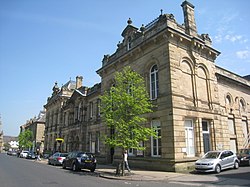
Queen's Hall, Hexham
The Queen's Hall, formerly Hexham Town Hall, is a municipal structure in Beaumont Street, Hexham, Northumberland, England. The structure, which was the headquarters of Hexham Urban District Council and is now an arts centre, is a Grade II listed building.

117 m
Battle of Hexham
The Battle of Hexham, 15 May 1464, marked the end of significant Lancastrian resistance in the north of England during the early part of the reign of Edward IV.
The battle was fought near the town of Hexham in Northumberland. John Neville, later to be 1st Marquess of Montagu, led a modest force of 3,000-4,000 men, and routed the rebel Lancastrians. Most of the rebel leaders were captured and executed, including Henry Beaufort, Duke of Somerset, and Lord Hungerford. Henry VI, however, was kept safely away (having been captured in battle three times earlier), and escaped to the north.
With their leadership gone, only a few castles remained in rebel hands. After these fell later in the year, Edward IV was not seriously challenged until the Earl of Warwick changed his allegiance from the Yorkist to the Lancastrian cause in 1469.