Old Hall is a historic building in Bellerby, a village in North Yorkshire in England. The first mention of the manor house is from 1575, when Thomas Metcalfe's will names eight rooms: parlour, buttery, chamber over the parlour, storehouse next the same chamber, chamber over the hall, chamber over the kitchen, kitchen and hall. His will also details the furnishings of the house. The hall was rebuilt in the early 17th century, since when the main changes have been the replacement of many of the windows in the Georgian period, and the addition of a 20th-century porch on the east side. The building was grade II* listed in 1967. The three-storey building is constructed of limestone rubble, with sandstone dressings, and a stone slate roof. It has an L-shaped plan, with the wing projecting to the rear left. Each bay has a stone coped gable with shaped kneelers and a ball finial, and to the left of the left bay is a coped parapet. The right bay projects as a tower porch, it contains a doorway with a quoined surround and a cambered lintel with a triangular soffit, and the inner doorway has a Tudor arch. The windows are double-chamfered and mullioned, some with hood moulds. Inside, original features include a Tudor-arched fireplace in the downstairs left room, and two smaller similar fireplaces on the first floor, and three doors: one leading out of the hall, and two to first-floor cupboards. Several original beams are visible, including one with early iron straps.

1. See also

Grade II* listed buildings in North Yorkshire (district) Listed buildings in Bellerby

1. References
Nearby Places View Menu
Location Image
47 m

Bellerby

Bellerby is a village and civil parish in North Yorkshire, England, about 7 miles (11 km) south-west of Richmond. The village has one pub, the Cross Keys, a small and historic Anglican church and a Methodist chapel. It is 1.5 miles (2.4 km) from the market town of Leyburn. Bellerby is approximately 250 miles (400 km) north of London. Bellerby is situated 673 feet (205 m) above sea level and is surrounded by low-lying hills with an open south-easterly aspect. Moorland is located to the North and the West of the village. Becks are an attractive feature of the village, which boasts many. The residents of Bellerby are also proud of their large population of ducks who thrive in the becks and in the suitable gardens of many friendly residents. The closest big town is Leyburn. From 1974 to 2023 it was part of the district of Richmondshire, it is now administered by the unitary North Yorkshire Council.
Location Image
89 m

St John's Church, Bellerby

St John's Church is the parish church of Bellerby, a village in North Yorkshire, in England. The first reference to a church in Bellerby is from the 15th century, and in 1474 it was the subject of a papal bull establishing the funding of a resident priest, who would say mass. It long served as a chapel-of-ease to St Michael's Church, Spennithorne. It was rebuilt in 1801, and again in 1874. In 1847, it was licensed for baptisms, marriages and burials. In 1967, the church was Grade II listed. The church was re-roofed and redecorated in 2005, with a carpet fitted the following year. The church bell was removed in 2017 as it was unsafe, but was rehung in 2021. The church is built of stone with a Welsh slate roof. It consists of a three-bay nave with a south porch, a two-bay chancel with a north vestry, and a southwest steeple. The steeple is octagonal with string courses, louvred openings, and an octagonal spire. The porch is gabled and has buttresses, and a pointed doorway with a chamfered surround.
Location Image
2.0 km

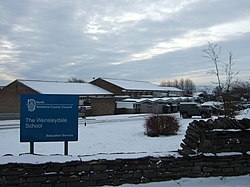
The Wensleydale School

The Wensleydale School and Sixth Form is a co-educational comprehensive school situated on Richmond Road, Leyburn, North Yorkshire, England.
Location Image
2.1 km

Leyburn Sham Castle

Leyburn Sham Castle is a historic structure in Leyburn, a town in North Yorkshire, in England. The folly lies in the grounds of Thornborough Hall, north of the house. It was built in about 1790, in the Gothic style, for Ralph and Molly Riddell. It is purely decorative, being very narrow against the hillside behind, and each of the two storeys can only be accessed from the hillside. Barbara Jones described as "one of the prettiest and most peaceful little sham castles in England". It was restored in the 1990s, and was grade II listed in 1998. The structure is built of stone and brick, and in the form of a square keep, with circular towers at each corner, and an octagonal turret. On the front is a round-headed brick arch with a keystone. The central doorway has a flat head under a pointed arch, and the windows have pointed heads. The towers have arrow slits, and windows with pointed heads above.