

 English
 Français
Central Landing Establishment
The Central Landing Establishment was the Second World War British development centre for airborne warfare at RAF Ringway airfield near Manchester.
Nearby Places View Menu

165 m
History of Manchester Airport
The origins of Manchester Airport in England, UK, date back to the 1930s. Construction started on Ringway on 28 November 1935 and it opened partly in June 1937 and completely on 25 June 1938, in Ringway parish north of Wilmslow, from which it derived its original name Manchester (Ringway) Airport. Its north border was Yewtree Lane. Its southeast border was a little northwest of Altrincham Road (Styal).
Local roads relevant to this account, on the map below:
Yewtree Lane: the lane from the junction by Firtree Farm west to The Grange (east of the crossroads marked "Ringway"), and continuing northwest past Manor Farm to the next junction.
Altrincham Road (Styal): the lane from Oversleyford running northeast then east into the Styal area.
In World War II, it was the location of RAF Ringway, and was important in the production and repair of military aircraft and training parachutists.
After World War II, it gradually expanded to its present size, including massive expansion of aprons, runways, and car parking areas. Among the first expansions were car parking and service buildings north of Yewtree Lane.
From 1958 to late 1962, Terminal 1 was built: this was the first of Ringway's modern large terminals and the first major public building north of Yewtree Lane.
In 1997, the second runway was planned and construction on it started, with protests about it intruding on woodland in the Styal area.

165 m
Manchester Airport
Manchester Airport (IATA: MAN, ICAO: EGCC) is an international airport in Ringway, Manchester, England; it lies 7 miles (11 km) south-west of Manchester city centre. In 2024, it was the third-busiest airport in the United Kingdom in terms of passengers (the busiest outside London), and the 19th-busiest airport in Europe in 2024, with 30.9 million passengers served.
The airport comprises a cargo terminal and three passenger terminals – although a £1.3 billion redevelopment programme will merge Terminals 1 and 3 in 2025. It covers an area of 560 hectares (1,400 acres) and has flights to 199 destinations, placing the airport thirteenth globally for total destinations served.
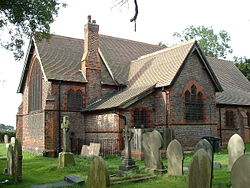
Officially opened on 25 June 1938, it was initially known as Ringway Airport. During the Second World War, as RAF Ringway, it was a base for the Royal Air Force. The airport is owned and managed by Manchester Airports Group (MAG), a group owned by the ten metropolitan borough councils of Greater Manchester, with Manchester City Council owning the largest stake, and the Australian finance house IFM Investors. Ringway, after which the airport was named, is a village with a few buildings and a church at the western edge of the airport.
In 2017, an eight-year redevelopment programme commenced which will culminate with the closure of Terminal 1 and enlargement of Terminal 2 to better facilitate transfers. The new terminal, due for completion in 2025, will take 80% of all passenger traffic. Terminal 3 will remain with a focus on low-cost, short-haul airlines.
166 m
RAF Ringway
RAF Ringway was a Royal Air Force satellite station at Ringway, Cheshire, England, near Manchester. It was operational from 1939 until 1957. The site is now occupied by Manchester Airport.
450 m
Ringway, Manchester
Ringway is a civil parish on the southern border of Manchester, England. Historically in Cheshire, it is the only civil parish in the city of Manchester. The population at the 2011 census was 103. Ringway is home to Manchester Airport.