L'Angleterre du Nord-Ouest est une région au nord-ouest de l'Angleterre. Ses administrations sont localisées à Liverpool et Manchester.

Sa superficie est de 14 168 km2 (6e région). D'après le recensement de 2011, sa population est de 7 052 000 habitants (3e région), soit une densité de 498 hab./km2.

1. Divisions administratives

Légende

AU : autorité unitaire (à la fois comté et district non métropolitain) CNM : comté non métropolitain CM : comté métropolitain

1. Villes principales

Blackpool Liverpool (administrations de région) Manchester (administrations de région) Preston Chester Lancastre

1. Autres villes

Accrington Ashton-under-Lyne Altrincham Barrow-in-Furness Birkenhead Blackburn Bolton Burnley Bury Buxton Carlisle Chorley Clitheroe Congleton Crewe Eccles Ellesmere Port Great Harwood Hoylake Harrow Kendal Keswick Knowsley Knutsford Macclesfield Maghull Nantwich Oldham Ramsbottom Rochdale St Helens Salford Shaw and Crompton Southport Stalybridge Stockport Stretford Trafford Warrington Whitehaven Wigan

1. Axe routier

A591

1. Liens externes

Site officiel

Portail de l’Angleterre

Nearby Places View Menu
Location Image
0 m

North West England

North West England is one of nine official regions of England and consists of the ceremonial counties of Cheshire, Cumbria, Greater Manchester, Lancashire and Merseyside. The North West had a population of 7,417,397 in 2021. It is the third-most-populated region in the United Kingdom, after the South East and Greater London. The largest settlements are Manchester and Liverpool. It is one of the three regions, alongside North East England and Yorkshire and the Humber, that make up Northern England.
Location Image
598 m

Lancaster University Boat Club

Lancaster University Boat Club (LUBC) is the rowing club of Lancaster University. The club was founded in 1964 with the inception of the university by Sir Harold Parkinson and is the oldest sports club at the university. The club is based in the old Halton railway station and trains on a 3 km stretch of the River Lune, 3 miles north of Lancaster.
Location Image
653 m

Halton railway station (Lancashire)

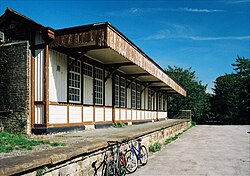
Halton railway station served the village of Halton in Lancashire, England. It closed in 1966, but the station building and part of one platform survive beside the cycle path along the disused line. In reference books the station is sometimes referred to as Halton (Lancs) to distinguish it from another Halton railway station in Cheshire (now also disused).
Location Image
726 m

Halton-with-Aughton

Halton-with-Aughton is a civil parish and electoral ward located 3 miles (5 km) east of Lancaster, England, on the north bank of the River Lune. The main settlement is the village of Halton, or Halton-on-Lune, in the west, and the parish stretches to the hamlet of Aughton in the east. It lies in the City of Lancaster district of Lancashire, and has a population of 2,227, down from 2,360 in 2001.
Location Image
1.1 km

Halton Cross

The Halton Cross, also known as Sigurd's Cross, is a composite high cross in the churchyard of St Wilfrid's Church, Halton-on-Lune, Lancashire. A 19th-century reconstruction, it comprises the remaining fragment of the original 10th- or 11th-century cross together with several 8th- or 9th-century fragments found locally. All feature carvings, some abstract and some representational. The carvings on the remains of the original cross, to be seen at the base of the shaft, show scenes from the legend of Sigurd, a part of the Germanic Nibelung tradition, together with Christian symbols. It has been called "an important survival from the twilight years when Christianity and paganism battled in the minds of men", and the archaeologist B. J. N. Edwards considered it "probably the clearest representation of part of the Sigurd story outside Scandinavia".