

 English
 Français
Edge Hill railway works
Edge Hill railway works was built by the Liverpool and Manchester Railway around 1830 at Edge Hill, Liverpool. A second was built in 1839 by the Grand Junction Railway adjacent to it.
Nearby Places View Menu
166 m
Wavertree Road Ground
Wavertree Road Ground was a cricket ground in Liverpool, Lancashire. The first recorded match on the ground was in 1847, when Liverpool played Birkenhead Park.
In 1859, the ground held its first first-class match when the Gentlemen of the North played the Gentlemen of the South. The first-class match was held on the ground in 1863 when the North played the South. Lancashire played a single first-class match there in 1866 against Surrey. The final first-class match there came in 1872 when the North played the South.
The final recorded match held on the ground came in 1880 when Wavertree played the Gentlemen of Canada. Shortly after this match, the ground was sold for development and built over.
331 m
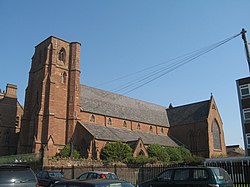
St Anne's Church, Edge Hill
St Anne's Church is in Overbury Street, Edge Hill, Liverpool, Merseyside, England. It is an active Roman Catholic parish church in the Archdiocese of Liverpool. In 1999 its parish was combined with that of the Church of St Bernard. The church is recorded in the National Heritage List for England as a designated Grade II listed building.

450 m
Kensington, Liverpool
Kensington is an inner city area of Liverpool, England. It is bordered by Everton to the north, Fairfield to the east, Edge Hill to the south, and the city centre to the west. The majority of Kensington is in the Kensington and Fairfield ward, while its westernmost part Kensington Fields is in the Central ward. At the 2001 Census, Kensington had a population of 12,740.

473 m
Williamson Tunnels
The Williamson Tunnels are a series of extensive subterranean excavations in the Edge Hill area of Liverpool, England. They are thought to have been created under the direction of tobacco merchant, landowner and philanthropist Joseph Williamson between 1810 and 1840. Although popularly described as "tunnels", the majority comprise brick or stone vaulting over excavations in the underlying sandstone. The purpose of the works remains unclear and remains a subject of heavy speculation; suggestions include commercial quarrying, a philanthropic desire to provide employment, and Williamson's own eccentric interests.
After being gradually infilled with rubble and spoil during the late 19th and early 20th centuries, they remained largely inaccessible until archaeological investigations were carried out in 1995. Since then volunteers have rediscovered and excavated an extensive network of tunnels, chambers and voids across several sites, with sections open to the public. Guided tours are available at the Williamson Tunnels Heritage Centre and the Friends of Williamson's Tunnels, and volunteers continue to uncover new sections.