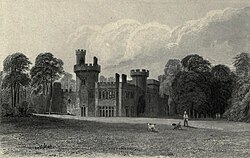
Childwall railway station was a station located on the North Liverpool Extension Line at Well Lane, Childwall, Liverpool. It opened on 1 December 1879. The station was distant from the village of Childwall. Passenger services ended in 1931 while it was still a village. The tracks were lifted in early 1979 when Childwall was a suburb of Liverpool with a large population.

1. History

Childwall railway station was situated on the Cheshire Lines Railway (CLC) North Liverpool Extension Line that connected the CLC Liverpool and Manchester line. The station opened on 1 December 1879 and took its name from the village which was east of the station. The station was on an embankment on the north side of Well Lane; it had a goods yard with one siding. Childwall station closed for passenger service on 1 January 1931, though it remained open for goods until August 1943. After it was fully closed, the station house was demolished. By 2015 the trackbed though the station site formed part of the Trans Pennine Trail.

1. References


1. = Sources =


1. External links

The station via Disused Stations UK The closed station on a 1948 O.S. map via npe Maps The station on an 1888 OS map overlay via National Library of Scotland The station and line HTS via railwaycodes The trackbed via Sustrans

Nearby Places View Menu
Location Image
383 m

Childwall

Childwall () is a suburb and ward of Liverpool, in Merseyside, England, located to the southeast of the city. It is bordered by Belle Vale, Bowring Park, Broadgreen, Gateacre, Mossley Hill, and Wavertree. In 2019, the population was 13,640.
Location Image
394 m

All Saints' Church, Childwall

All Saints' Church, is in Childwall, Liverpool, England. It is recorded in the National Heritage List for England as a designated Grade I listed building, and is the only medieval church remaining in the Metropolitan borough of Liverpool. It is an active Anglican parish church in the diocese of Liverpool, the archdeaconry of Liverpool and the deanery of Liverpool South – Childwall.
Location Image
631 m

Childwall Hall

Childwall Hall was a 19th-century English country house located in Childwall, Liverpool, England. Built on the site of a previous mansion of the same name the Gothic Revival building was the seat of parliamentarian Bamber Gascoyne (the younger), a noted opponent of the abolition of slavery. The main building was demolished in 1949 and the current site is now occupied by a television production company Lime Pictures. A lodge building and a few ruins of the same style are all that remain of the hall.
745 m

Court Hey Hall

Court Hey Hall was a mansion in England built for Robertson Gladstone (1805–1875), elder brother of William Gladstone. The hall was built c. 1836 in the west of what is now Knowsley borough in Merseyside. The architect may have been John Cunningham, the designer of Liverpool Lime Street railway station. The estate stayed in the Gladstone family until the death of one of his sons in 1919, then was purchased in the same year by J. Bibby and Sons, cattle food manufacturers. The hall was used as a sports and social centre for the Bibby employees. By 1948 the hall was beginning to deteriorate and in 1951 the company sold it and the estate to Huyton-With-Roby Council. The hall was demolished in 1956 and part of the grounds were turned into a public park called Court Hey Park; the remainder of the estate was used for housing development. Between 2001 and 2017 the park was the home of the National Wildflower Centre.