

 English
 Français
Ivory Bangle Lady
The Ivory Bangle Lady is a skeleton found in Sycamore Terrace, York in 1901. She was a high-status adult female, potentially of North African descent, who died in York in the 4th century AD during the Roman period. Her skeleton was found with bracelets, pendants, earrings, beads as well as a glass jug and mirror. A piece of bone inscribed with the words, "Hail, sister may you live in God" was found with her skeleton.
Nearby Places View Menu
159 m
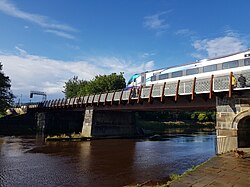
Scarborough Bridge, York
Scarborough Bridge carries the railway line to Scarborough over the River Ouse in York, England. The first bridge was built in 1845, and has been renovated and rebuilt at least twice since its initial opening. A new bridge was installed in 2015 at a cost of £6 million. The first bridge had a pedestrian walkway which was located between the two running lines on the deck of the bridge, this was later moved to the east side of the bridge (in the 1875 rebuild), and finally, in the 2010s rebuild, the walkway became a separate wider bridge. The bridge is still in daily use carrying Trans-Pennine services between Scarborough and either York, or Manchester and Liverpool.

195 m
Roots (restaurant)
Roots is a restaurant on Marygate, just north of the city centre of York in England.
The building was constructed as the Bay Horse public house between 1893 and 1894. It replaced an earlier pub of the same name, which was on the opposite side of the road. It was designed by Walter and Arthur Penty. From 1951 until 1986, it was run by Eve and Arthur Briggs. It closed in 2004, at which time it was owned by Wolverhampton and Dudley Breweries. In 2007, the brewery proposed converted the building into an office with flats above; however, it instead reopened as a pub in 2008.
In 2018, chef Tommy Banks and restaurateur Matthew Lockwood converted the building into a restaurant, named "Roots", which focuses on local produce and self-sufficiency. This became the first restaurant in the city to win a Michelin star, in 2021.
The two-storey building is Grade II listed. It is built of brick, with the first floor partly tile-hung, and partly covered with timber-framing. The ground floor windows and doors are surrounded by stone, and the roof is tiled. All three bays of the Marygate front are gabled; there is a half-octagonal tower at the right-hand side, and a central porch with a round arch. Above the door is a panel which reads "BUILT 1894". Most windows are mullioned and transomed, with some on the first floor diamond-paned. Inside, the basic room arrangement survives, although some walls were removed in the 20th century. Original features include the bar and two timber fireplaces, one of which has a carved panel above depicted a bay horse and dated 1898.
217 m
Queen Anne Grammar School
Queen Anne Grammar School for Girls was a single-sex state grammar school in the city of York, England. It began in 1906 as the Municipal Secondary School for Girls and was based in Brook Street. At the end of 1909 the pupils were transferred to a new 5+1⁄2-acre site in Clifton. The school was officially opened on 18 January 1910 by the Archbishop of York, Cosmo Gordon Lang.
The school's name was changed in 1920 and Queen Anne was chosen as it was situated on Queen Anne's Road. The school emblem was a sphinx underneath which was a furled ribbon reading the school motto Quod Potui Perfeci.
The school became a co-educational comprehensive in 1985 and was renamed Queen Anne School. It closed in June 2000 and in 2001 St Olave's School moved to the site.

220 m
The Garth
The Garth is a historic building on Marygate, immediately north of the city centre of York, in England.
The building was constructed in 1705, as the Grey Coat School, a charity school for girls. It accommodated up to 40 girls, who were fed, clothed and housed, and trained for domestic service. The school moved to Monkgate in 1784. In the late 19th century, the building was partly reconstructed, with many of the windows relocated. The building was later divided into flats, with many of the larger rooms subdivided. The north-west end of the building is now a separate property, known as "Little Garth", and a small part of the building has been incorporated into the neighbouring St Mary's Cottage. The building was Grade II listed in 1971.
The building has an L-shaped plan. The central part of the building is three storeys high, while the right hand wing is three storeys with an attic, and the left hand wing is two storeys with an attic. The building is constructed of brick, with a pantiled roof. The windows are in a variety of styles, and include a large oriel window in the centre of the first floor, and oculus windows to the attics. Above one of the doors to Marygate is part of a carved bargeboard, which is said to date from 1635 and have been relocated from a house on High Ousegate. The facade on Marygate Lane retains some original windows, and the left-hand facade has an original entrance door. No early features survive inside the building.