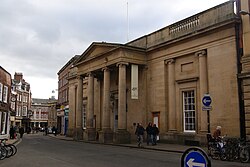
1 Museum Street is a historic building in the city centre of York, in England. The building was constructed in 1860, to a design by Rawlins Gould. It initially served as the city's register office. Later, it served as a Conservative Club, with committee rooms, a bar and a snooker room; it then became council offices. The building has two storeys and is built of orange brick, with stone dressings. It is of 11 bays, one of which curves around the corner from Museum Street into Blake Street. The main entrance is on Museum Street, and has double doors with a fanlight above. Most of the sash windows have four panes, although a few retain the original eight panes. The window pediments are alternately triangular and segmented. The upper floor has Doric order pilasters. In 1909, a brick balustrade was added to the roof. Inside, a grand staircase leads up to the first floor room, which contains a wooden tablet to the memory of John Hodgson, from Strensall. The room has housed meetings of the Board of Guardians of the York Poor Law Union. In 1986, the building was Grade II listed. In 2010, it was purchased by the York Conservation Trust, which renovated it to become the city's tourist information centre. The office remained there until 2022.

Nearby Places View Menu
Location Image
22 m

Museum Street Tavern

The Museum Street Tavern, formerly Thomas's of York, is a historic pub in the city centre of York, in England. The building which houses the pub was first constructed in about 1700. In about 1800, it became part of Ettridge's Royal Hotel, and at some point in the 1820s, it was heightened from two to three storeys. In 1858, it was bought by William Thomas, an experienced hotelier, who renamed the hotel after himself. The remainder of the old hotel was demolished, and the Museum Street facade of the remaining building was altered, with work completed in 1863. Thomas sold the pub in 1876, to Thomas Lightfoot, a brewer from Bedale, but its name was retained. In 1900, it was purchased by John Smith's Brewery. At the time, it had eight bedrooms, a bar, two drawing rooms, a coffee room and a billiard room. The building is constructed of dark brown brick. The staircase and some first-floor doors are original, while the fireplaces and some plaster work date from the 1863 alterations. There is late-19th-century stained glass around the wide door, with a colourful design in the tympanum above, incorporating the name "Thomas's Hotel". The pub was Grade II listed in 1978. By 2022, it was owned by the Stonegate Pub Company, which closed it for conversion into a Be At One cocktail bar. In 2023 it reopened as the Museum Street Tavern.
Location Image
31 m

York Assembly Rooms

The York Assembly Rooms is an 18th-century assembly rooms building in York, England, originally used as a place for high class social gatherings in the city. The building is situated on Blake Street and is a Grade I listed building. Designed by Richard Boyle, 3rd Earl of Burlington it is one of the earliest Palladian buildings in Northern England and possibly the earliest neoclassical building in Europe. Construction began in 1730 and was completed in 1735, but it was used beginning in 1732. After a fire in 1773, alterations were made to the Lesser Assembly Room to the designs of Sir John O'Corall. The front steps of the portico were later replaced by an internal set in 1791. Lord Burlington's original front facade was replaced in 1828 by a Greek Revival portico designed by J. P. Pritchett. In 1925, York Corporation purchased the building and made further alterations in 1939 through 1951. The York Conservation Trust purchased the Assembly Rooms in 2002 and are responsible for the building's maintenance. It currently operates as an Ask Italian but is open for public viewing.
Location Image
35 m

York Dispensary

The York Dispensary is a historic building in the city centre of York, in England. The York Dispensary was established in 1788 in a room in Merchant Adventurers' Hall. It provided free treatment to poor patients, and its doctors undertook home visits when necessary. In 1808, it moved into a house on St Andrewgate, then a purpose-built building on New Street in 1829. In 1899, it needed larger premises, and moved to a building on Duncombe Place, designed by Edmund Kirby and constructed at a cost of £6,000. The dispensary closed in 1948, following the founding of the National Health Service, and the following year, the building became a health service centre run by the city corporation. The building was Grade II listed in 1975. Kirby was originally commissioned by the firm of solicitors, Messrs Gray, Dodsworth and Cobb to build offices. When the neighbouring site was purchased by the dispensary, it also took on Kirby, and tasked him with constructing both buildings in the same style. The building is constructed of red brick, with moulded brick dressings, stone window surrounds, tiled roofs, finials in terracotta and wrought iron, and a weathervane in the style of a snake. It has two main storeys, a basement, and an attic, with various gables and turrets. The former dispensary has an arched entrance with original double doors, and a carved stone panel above displaying the city's coat of arms and the text "YORK DISPENSARY". There is also an arched carriage entrance, with wrought iron gates, with "PATIENTS ENTRANCE" inscribed above. Inside, the original dispensary and office staircases survive, as do various doors, architraves and cornices.
Location Image
36 m

York Oratory

The Oratory Church of Saint Wilfrid, York (or York Oratory for short) is a Catholic church in York, England. A church dedicated to Saint Wilfrid has stood in York since medieval times. It is within the Diocese of Middlesbrough and was the second pro-Cathedral of the Diocese of Beverley until its dissolution in 1878.