

 English
 Français

Tyldesley Urban District
Tyldesley cum Shakerley Urban District and its successor Tyldesley Urban District was, from 1894 to 1974, a local government district in Lancashire, England.
Nearby Places View Menu
0 m
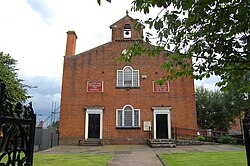
Tyldesley Top Chapel
The Tyldesley Top Chapel (grid reference SD695019) is a chapel in Tyldesley. It is a Grade II Listed building.
Top Chapel was built in 1789 on a site of 1,300 square yards at the top of Tyldesley Banks opposite the Square. The site and building materials were all provided by Thomas Johnson. It was properly known as "The Lady Huntingdon Chapel" but became known as Top Chapel because of its position at the top of Astley Street. Its first minister was J. Johnson who was ordained at Spa Fields Chapel London by the Countess of Huntingdon's Connexion.
Lady Selina Hastings, the Countess of Huntingdon had been greatly influenced by John Wesley and George Whitefield and set up the Calvinistic Connexion within the Methodist Church. The Connexion still has several chapels, mostly in the south of England.
7 m
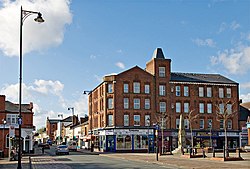
Tyldesley
Tyldesley () is a market town in the Metropolitan Borough of Wigan in Greater Manchester, England. Within the boundaries of the historic county of Lancashire, it is north of Chat Moss near the foothills of the West Pennine Moors, eight miles (13 kilometres) southeast of Wigan and nine miles (14 kilometres) northwest of Manchester. At the United Kingdom Census 2001, the Tyldesley built-up area subdivision, excluding Shakerley, had a population of 16,142.
The remains of a Roman road passing through the township on its ancient course between Coccium (Wigan) and Mamucium (Manchester) were evident during the 19th century. Following the Anglo-Saxon settlement of Britain, Tyldesley was part of the manor of Warrington, until the Norman Conquest of England, when the settlement constituted a township called Tyldesley-with-Shakerley in the ancient parish of Leigh.
The factory system and textile manufacture during the Industrial Revolution triggered population growth and urbanisation, and by the early 20th century it was said that the mill town was "eminently characteristic of an industrial district whose natural features have been almost entirely swept away to give place to factories, iron foundries, and collieries". After industrial activity declined in the late 20th century, land reclamation and post-war residential developments have altered the landscape and encouraged economic activity along Elliott Street.
222 m
Barnfield Mills
Barnfield Mills was a complex of cotton mills that operated in Tyldesley, Greater Manchester, England from the middle of the 19th century.
247 m
Shakerley Colliery (Greens)
Shakerley Colliery was a coal mine on the Manchester Coalfield near Shakerley, Tyldesley, Greater Manchester, then in the historic county of Lancashire, England. It was sunk in 1867 and was operating in 1878.
The colliery on Shakerley Common had a single shaft which was sunk to the Rams mine at 300 feet by George Green to exploit the Middle Coal Measures of the Lancashire Coalfield and became part of the Tyldesley Coal Company in 1870. It had the first iron headgear in the country but closed by 1886.