

 English
 Français
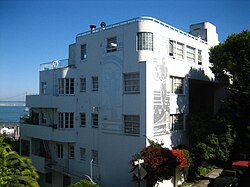
Malloch Building
The Malloch Building is a private residential apartment building on Telegraph Hill in San Francisco designed in the Streamline Moderne style and built in 1937. The building, one of the best examples of its type in San Francisco, is also known as Malloch Apartments, Malloch Apartment Building, and simply by its address: 1360 Montgomery Street. Some have called it the "Ocean-Liner House", though other Moderne buildings have also been known by that nickname. Designed by Irvin Goldstine for contractor John "Jack" S. Malloch and his publisher son, John Rolph Malloch, the building was used as a filming location in 1947's Dark Passage, a noir work starring Humphrey Bogart and Lauren Bacall.
Nearby Places View Menu

131 m
Sidney Kahn House
The Sidney Kahn House is a four-story residential building in Telegraph Hill, San Francisco, California designed by architect Richard Neutra in 1939. The building is Neutra's most famous house in San Francisco.
The building's top floor is designed as a living room and bar while its middle two floors hold bedrooms. The house notably features a number of south and east-facing balconies that affording views of the Financial District and East Bay.
In addition to the design of the house, the Khans commissioned Neutra to design furnishings. Most notable of the resulting designs was the "camel" table featuring legs that could "kneel," lowering it to a coffee-table height.
The building was subdivided into two smaller units by a later owner, yet has since been re-unified into one house.
The house is near 42 Calhoun Terrace, where Diego Rivera and Frida Kahlo lived briefly in 1940.

141 m
Telegraph Hill, San Francisco
Telegraph Hill (elev. 285 ft (87 m)) is a hill and surrounding neighborhood in San Francisco, California. It is one of San Francisco's 44 hills, and one of its original "Seven Hills". The iconic Coit Tower stands at the apex of Telegraph Hill.

142 m
Julius' Castle
Julius' Castle is a castle-shaped building that sits at 1541 Montgomery Street on Telegraph Hill in San Francisco. It served as a visual landmark and as a restaurant for many years, originally opening between 1924 and 1928. Since 1980, the building has been listed as a San Francisco Landmark Number 121. The architecture is described by the San Francisco Planning Department as, "primarily derived from the Gothic Revival and Arts & Crafts Styles".

142 m
Coit Tower
Coit Tower ( KOYT; also known as Coit Memorial Tower) is a 210-foot (64 m) tower in the Telegraph Hill neighborhood of San Francisco, California, overlooking the city and San Francisco Bay. The tower, in the city's Pioneer Park, was built between 1932 and 1933 using Lillie Hitchcock Coit's bequest to beautify the city of San Francisco. It was added to the National Register of Historic Places on January 29, 2008.
The Art Deco tower, built of unpainted reinforced concrete, was designed by architects Arthur Brown Jr. and Henry Temple Howard. The interior features fresco murals in the American Social Realism style, painted by 22 different onsite artists and their numerous assistants. Three artists preferred oil on canvas and worked offsite. One artist preferred egg tempera rather than fresco.
It is often erroneously stated that the structure was dedicated to the volunteer firemen who had died in San Francisco's five major fires, but that is not accurate. The tower was constructed as the result of a bequest by Lillie Hitchcock Coit, whose will included two bequests, one to create a memorial to the city's volunteer firefighters, which was done by statuary in Washington Square, and the other to beautify the city. Coit Tower is the result of the second bequest. A concrete relief of a phoenix by sculptor Robert Boardman Howard is placed above the main entrance. It was commissioned by the architect and cast as part of the building.
Although an apocryphal story claims that the tower was designed to resemble a fire hose nozzle due to Coit's affinity with the San Francisco firefighters of the day, the resemblance is coincidental.