

 English
 Français

Derventio Brigantum
Derventio, sometimes described as Derventio Brigantium (Latin for "Derventio of the Brigantes") in order to distinguish it from other places called Derventio, was a Roman fort and settlement located beneath the modern town of Malton in North Yorkshire, England. The fort is 18 miles north-east of Eboracum on the River Derwent.
Nearby Places View Menu

163 m
Malton Lodge
Malton Lodge, also known as the Old Lodge, is a historic building in Malton, North Yorkshire, a town in England.
In 1569, Ralph Eure, 3rd Baron Eure built a large house on the site of Malton Castle. His family constructed a gatehouse to the property in 1604. In 1674, the main house was demolished, but the gatehouse was retained and altered to form "Malton Lodge". In about 1834, it was extended on both sides, and in 1878 it was again extended to the left, with outbuildings further to the left. The building was Grade II* listed in 1951. It currently serves as a hotel.
The building is constructed of sandstone with a pantile roof. The entrance front has two storeys and five bays, with a one-storey three-bay extension to the right, a two-storey two bay extension to the left, and later extensions further to the left. The middle three bays of the entrance front project, and have paired Tuscan and Doric columns, a moulded string course, a moulded eaves cornice and an embattled parapet flanked by ogee-headed turrets. In the centre of the front is a round arch with a keystone, and an inserted doorway and lunette. Most of the windows are mullioned, some with hood moulds, and in the centre of the parapet is a panel with a moulded surround. Inside, there are two 17th-century staircases and Jacobean woodwork including an elaborate fireplace.
A 70-metre (230 ft) stretch of the screen wall to the outer forecourt of the former house survives in the grounds of the lodge, and is separately Grade II* listed. The wall is built of sandstone with sloped coping, and is about 5 metres (16 ft) tall, rising to 6.5 metres (21 ft) over the arches. In the centre is a round arch of voussoirs, now partly blocked, with paired pilasters on bulbous moulded pedestals, imposts, a frieze and a moulded projecting cornice. To the left is an elliptical arch between pilaster buttresses.

197 m
Malton Castle
Malton Castle was a castle in Malton, North Yorkshire, England. A wooden motte and bailey castle was built by William Tyson, lord of Alnwick in the 11th century, on the site of the Roman fort of Derventio Brigantum. The castle was given to Eustace Fitz John, who rebuilt it in stone.
Eustace negotiated the delivery of the castle to King David I of Scotland in 1138. The Scots garrisoned the castle, however it was captured later the same year. King Richard I of England visited the castle in 1189 and King Edward II of England in 1307. When Eustace de Vesci rebelled against King John in 1212, he gave orders to destroy (slight) de Vesci's castles at Malton and Alnwick. The castle was held against King John of England, during the First Barons' War. After the battle of Old Byland the castle was captured and destroyed by King Robert I of Scotland in 1322. The castle was not repaired and fell into ruins. Only the former gatehouse and some short sections of original medieval curtain wall still exist. The gatehouse is now used as a hotel.
A house was built on the site in 1569 by Ralph, Lord Eure, which came to be inherited by two sisters of the Eure family, Margaret and Mary. In 1674 they fell out over ownership and took their argument to the County Sheriff, who destroyed the house and put the stones into two equal piles for the sisters to share.
The site is now a scheduled monument.

309 m
St Leonard & Mary, Malton
St Leonard & Mary Catholic Church is a medieval church situated in Malton, North Yorkshire, England, now serving a parish in the Roman Catholic Diocese of Middlesbrough. It is a Grade II* listed building in the National Heritage List for England, and retains at least 24 pieces of medieval figurative carving.
A notice outside of the church reads: "St Leonard's with St Mary's. Founded in the 12th century as a Chapel of Ease to the Gilbertine Priory at Old Malton. This Church was transferred by way of gift as an ecumenical gesture of goodwill from the Church of England to the Roman Catholic Church in 1971."
Dating as it does from the mid- to late-1100s, this church is the oldest currently held by Catholics in England, a distinction formerly belonging to St Etheldreda's, London, which was built some time between 1250 and 1290. St Leonard's is the first English parish church to be returned to Roman Catholic use following the Reformation.
313 m
Ryedale District
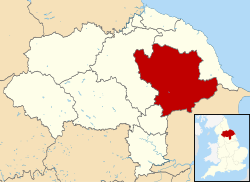
Ryedale was a non-metropolitan district in North Yorkshire, England. It was in the Vale of Pickering, a low-lying flat area of land drained by the River Derwent. The Vale's landscape is rural with scattered villages and towns. It has been inhabited continuously from the Mesolithic period. The economy was largely agricultural with light industry and tourism playing an increasing role.
Towns included Helmsley, Kirkbymoorside, Malton, Norton-on-Derwent, and Pickering. Part of Ryedale lies within the North York Moors National Park. The A64 passed through Ryedale and villages such as Rillington. In the 2011 Census, the population of this primarily rural area of 150,659 hectares, the largest district in North Yorkshire, was 51,700.