

 English
 Français

Royal Albert Dock
Le Royal Albert Dock est un complexe de docks et d'entrepôts situé en Angleterre, à Liverpool. Conçu par Jesse Hartley et Philip Hardwick, il a été construit en 1846 comme un « bassin à flot » en bordure du fleuve Mersey. Longtemps connu comme l'« Albert Dock », le complexe se voit octroyer une charte royale en juin 2018 et « Royal » est ajouté à son nom. Au XIXe siècle, alors que le pays est en pleine révolution industrielle, le port de Liverpool devient le plus important de l'Empire britannique quant au trafic et sert de lieu d'arrivée de produits exotiques comme le brandy, le coton, le thé, la soie, le tabac, l'ivoire et le sucre. Le port servait aussi de point de départ pour le transport commercial des innovations anglaises.
Nearby Places View Menu

0 m
Royal Albert Dock, Liverpool
The Royal Albert Dock is a complex of dock buildings and warehouses in Liverpool, England. Designed by Jesse Hartley and Philip Hardwick, it was opened in 1846, and was the first structure in the United Kingdom to be built from a combination of cast iron, brick, and stone without also using wood for any structural element. As a result, it was the first non-combustible warehouse system in the world. It was known simply as the Albert Dock until 2018, when it was granted a royal charter and had the honorific "Royal" added to its name.
At the time of its construction, the dock was considered to be revolutionary in its design because ships were loaded and unloaded directly from or to the warehouses. Two years after it opened, it was modified to feature the world's first hydraulic cranes. Due to its open yet secure design, the dock became a popular store for valuable cargoes such as brandy, cotton, tea, silk, tobacco, ivory and sugar. However, despite its advanced design, the rapid development of shipping technology meant that, within 50 years, larger and more open docks were required, although the Albert Dock remained a valuable store for cargo.
During the Second World War, the dock was requisitioned by the Admiralty serving as a base for ships of the British Atlantic Fleet. The complex was damaged during air raids on Liverpool, notably during the May Blitz of 1941. In the aftermath of the war, the financial problems of the owners and the general decline of docking in the city meant that the future of the Albert Dock was uncertain. Numerous plans were developed for the re-use of the buildings but none came to fruition and in 1972 the dock was finally closed. Having lain derelict for nearly ten years, the redevelopment of the dock began in 1981, when the Merseyside Development Corporation was set up, with the Albert Dock being officially re-opened in 1984.
Today the Royal Albert Dock is a major tourist attraction in the city and the most visited multi-use attraction in the United Kingdom, outside London. The five warehouses which make up the complex cover 1.25m sq ft in size, the biggest such group of Grade I listed buildings anywhere in the UK.

80 m
Merseyside Maritime Museum
The Merseyside Maritime Museum is a museum based in the city of Liverpool, Merseyside, England. It is part of National Museums Liverpool and an Anchor Point of ERIH, The European Route of Industrial Heritage. It opened for a trial season in 1980 before fully opening in 1984 and expanding in 1986. The museum occupies warehouse block D at the Albert Dock, along with the Piermaster's House, Canning Half Tide Dock and Canning Graving Docks.

80 m
International Slavery Museum
The International Slavery Museum is a museum located in Liverpool, UK, that focuses on the history and legacy of the transatlantic slave trade. The museum, which forms part of the Merseyside Maritime Museum, consists of three main galleries which focus on the lives of people in West Africa, their eventual enslavement, and their continued fight for freedom. Additionally the museum discusses slavery in the modern day as well as topics on racism and discrimination.
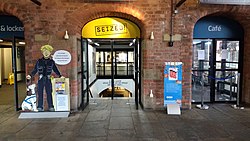
101 m
Border Force National Museum
The Border Force National Museum (previously - UK Border Agency) is located in Liverpool, England and holds the national collection of HM Revenue and Customs, one of the most important collections of its type held anywhere in the world. Originally HM Customs & Excise National Museum, the collection is now a gallery located on the basement floor of the Merseyside Maritime Museum at the Albert Dock.

120 m
The Beatles Story
The Beatles Story is a museum in Liverpool about the Beatles and their history. It was devised and created by Mike and Bernadette Byrne and officially opened on 1 May 1990. It is located on the historical Royal Albert Dock, and is owned by Mersey Ferries, part of Merseytravel.
The Beatles Story contains recreations of The Casbah Coffee Club, The Cavern Club and Abbey Road Studios among other historical Beatles items, such as John Lennon's spectacles, George Harrison's first guitar and a detailed history about the British Invasion and the solo careers of every Beatle. The museum was also recognised as one of the best tourist attractions of the United Kingdom in 2015. The exhibition was preceded by the Cavern Mecca (1981–1984) and Beatles City (1984–1986).