La Boca est un quartier (barrio) proche du centre de Buenos Aires, en Argentine. Il est situé au sud-est du centre, près du port, entouré de Barracas à l'ouest, et San Telmo et Puerto Madero au nord. Il porte le nom de "La Boca" (la bouche) car il s'élève autour de l'une des embouchures du Riachuelo.

1. Histoire

Il abrite de nombreux habitants originaires d'Italie. À la suite d'une longue grève générale en 1882, une rébellion proclama une sécession de la Boca vis-à-vis de l'Argentine, et dressa le drapeau génois. Le régime argentin réprima rapidement cette rébellion, et le président Julio Argentino Roca retira lui-même ce drapeau génois. Aujourd'hui, le quartier de La Boca est très prisé par les touristes qui viennent admirer en masse les façades colorées des maisons, et apprécier le rythme de vie animé du quartier, tout en déambulant dans la rue Caminito. La Boca est un quartier pauvre de Buenos Aires. C'est également un quartier où se concentrent des courants politiques de gauche, ses habitants ayant élu en 1935 le premier membre du Congrès argentin socialiste, Alfredo Palacios. Durant la crise économique qui frappa durement l'Argentine en 2001, La Boca fut le théâtre de nombreuses manifestations.

1. Sport

La Boca est également mondialement connue pour son club de football, le Club Atletico Boca Juniors, où a joué Diego Maradona, ainsi que son terrible stade, La Bombonera.

1. Galerie


1. Voir aussi

La liste des quartiers de Buenos Aires.

1. Notes et références

Portail de Buenos Aires

Lieux à Proximité Voir Menu
Location Image
0 m

La Boca

La Boca (Spanish: [la ˈβoka]; "the Mouth", probably of the Matanza River) is a neighborhood (barrio) of Buenos Aires, the capital of Argentina. Its location near the Port of Buenos Aires meant the neighbourhood became a melting pot of different cultures during the 20th century, when millions of immigrants from Europe and Asia arrived to Argentina. In particular, many of its settlers originated from the Italian region of Liguria. The neighbourhood became a cornerstone for porteño culture, being an important site during the early development of the tango. Today, it is mostly known for being home to Boca Juniors, one of the two largest sports clubs in Argentina.
Location Image
452 m

Caminito

Caminito ("little walkway" or "little path" in Spanish) is a street museum and a traditional alley, located in La Boca, a neighborhood of Buenos Aires, Argentina. The place acquired cultural significance because it inspired the music for the famous tango "Caminito (1926)", composed by Juan de Dios Filiberto. Nearby is the Vuelta de Rocha, historic place of Buenos Aires City.
Location Image
502 m

Casa Amarilla

Casa Amarilla (in English: "Yellow House") was a railway station in the district of La Boca, Buenos Aires, built and operated by the Buenos Aires and Ensenada Port Railway. Its name was inspired on Irish Admiral William Brown's house, built in the same district and painted in yellow. Brown was one of the heroes of Argentine War of Independence leading the Argentine Navy.
Location Image
524 m

Fundación Proa

The Fundación Proa is a private art center in La Boca, Buenos Aires, Argentina. It was founded in 1996 and develops educational programs and exchange with cultural institutions. Its focus is on the dissemination of the great artistic movements of the twentieth century. The foundation is located at Pedro de Mendoza Avenue, 1929.
Location Image
828 m

Puente Transbordador

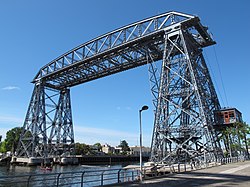
Puente Transbordador (also known as Buenos Aires Transporter Bridge, Puente Transbordador de La Boca Puente Transbordador Nicolás Avellaneda, Antiguo Puente Nicolás Avellaneda or Transbordador del Riachuelo) is a transporter bridge in Buenos Aires, Argentina. The bridge was in use from its completion in 1914 until 1960, when operation ceased until 2017. Since 1999 the bridge is a National Historic Monument of Argentina. The transporter bridge was the first link to connect Buenos Aires with the outskirts on the other side of the Riachuelo River. The bridge links the Avenida La Plata in the neighbourhood Island Maciel of Dock Sud with Avenida Almirante Brown in the La Boca neighbourhood of Buenos Aires. The name of the bridge refers to Nicolás Avellaneda, a former president of Argentina, who also gave the name to the Avellaneda Partido on the right bank of the river. The platform of the transporter bridge measured 8 by 12 metres and could be operated from a control stand on itself or from the machine house. It was designed to carry pedestrians, carts, cars and trams.