Caminito ("little walkway" or "little path" in Spanish) is a street museum and a traditional alley, located in La Boca, a neighborhood of Buenos Aires, Argentina. The place acquired cultural significance because it inspired the music for the famous tango "Caminito (1926)", composed by Juan de Dios Filiberto. Nearby is the Vuelta de Rocha, historic place of Buenos Aires City.

1. History

During the 1800s, a small stream flowing into the Riachuelo River ran along the same route where the Caminito is now. Later that century, this area of the stream became known as the Puntin, the Genoese diminutive term for bridge (a small bridge allowed people to cross the stream there). When the stream dried up, tracks for the Ferrocarril Buenos Aires y Puerto de la Ensenada were installed at the site. Disused tracks remain at the end of Caminito, along Garibaldi Street. In 1954, the railroad closed, and the area where Caminito was became a landfill and the neighborhood's eyesore. Over the following three years, Argentine artist Benito Quinquela Martín who lived nearby, painstakingly prepared the walls facing the abandoned street, applying pastel colors, and by 1960 had a stage put up at the southern end; the wooden-plank stage was replaced with a nearby theatre house in 1972. The artist was a personal friend of Argentine tango composer Juan de Dios Filiberto, who created a well-known 1926 tune by the same name.

1. References


1. External links

Caminito Street in La Boca neighbourhood

Nearby Places View Menu
Location Image
86 m

Fundación Proa

The Fundación Proa is a private art center in La Boca, Buenos Aires, Argentina. It was founded in 1996 and develops educational programs and exchange with cultural institutions. Its focus is on the dissemination of the great artistic movements of the twentieth century. The foundation is located at Pedro de Mendoza Avenue, 1929.
Location Image
452 m

La Boca

La Boca (Spanish: [la ˈβoka]; "the Mouth", probably of the Matanza River) is a neighborhood (barrio) of Buenos Aires, the capital of Argentina. Its location near the Port of Buenos Aires meant the neighbourhood became a melting pot of different cultures during the 20th century, when millions of immigrants from Europe and Asia arrived to Argentina. In particular, many of its settlers originated from the Italian region of Liguria. The neighbourhood became a cornerstone for porteño culture, being an important site during the early development of the tango. Today, it is mostly known for being home to Boca Juniors, one of the two largest sports clubs in Argentina.
Location Image
603 m

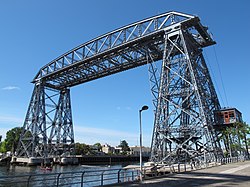
Puente Transbordador

Puente Transbordador (also known as Buenos Aires Transporter Bridge, Puente Transbordador de La Boca Puente Transbordador Nicolás Avellaneda, Antiguo Puente Nicolás Avellaneda or Transbordador del Riachuelo) is a transporter bridge in Buenos Aires, Argentina. The bridge was in use from its completion in 1914 until 1960, when operation ceased until 2017. Since 1999 the bridge is a National Historic Monument of Argentina. The transporter bridge was the first link to connect Buenos Aires with the outskirts on the other side of the Riachuelo River. The bridge links the Avenida La Plata in the neighbourhood Island Maciel of Dock Sud with Avenida Almirante Brown in the La Boca neighbourhood of Buenos Aires. The name of the bridge refers to Nicolás Avellaneda, a former president of Argentina, who also gave the name to the Avellaneda Partido on the right bank of the river. The platform of the transporter bridge measured 8 by 12 metres and could be operated from a control stand on itself or from the machine house. It was designed to carry pedestrians, carts, cars and trams.
Location Image
664 m

Puente Nicolás Avellaneda

Puente Nicolás Avellaneda is a 1650-metre-long liftable road bridge with two lanes in Buenos Aires, Argentina over Riachuelo River, which was built from 1937 to 1940. The 57-metre-tall (187 ft) liftable section over the river has a length of 60 metres and offers a clearance of 43 metres when lifted, and a clearance of 21 metres when not lifted. This section of the bridge carries a transporter gondola and can work like the nearby Puente Transbordador as a transporter bridge. The transporter gondola was designed to allow horse-driven wagons to cross the river without using the long strenuous way over the ramps of the bridge. Puente Nicolás Avellaneda is the only liftable bridge in the world equipped with a transporter gondola. However since 1960, this gondola is only in use when the roadway on the bridge is closed for maintenance work.